

|
|
4.1 - Stream Habitat Walk
4.2 - Streamside Biosurvey
4.3 - Intensive Stream Biosurvey
Biological monitoring, the study of biological organisms and their responses, is used to determine environmental conditions. One type of biological monitoring, the biological survey or biosurvey, is described in this chapter. The biosurvey involves collecting, processing, and analyzing aquatic organisms to determine the health of the biological community in a stream.
In wadable streams (streams that can be easily walked across, with water no deeper than about thighhigh), the three most common biological organisms studied are fish, algae, and macroinvertebrates. This manual discusses macroinvertebrate monitoring only.
Macroinvertebrates are organisms that are large (macro) enough to be seen with the naked eye and lack a backbone (invertebrate). They inhabit all types of running waters, from fastflowing mountain streams to slowmoving muddy rivers. Examples of aquatic macroinvertebrates include insects in their larval or nymph form, crayfish, clams, snails, and worms (Fig. 4.1). Most live part or most of their life cycle attached to submerged rocks, logs, and vegetation.
Aquatic macroinvertebrates are good indicators of stream quality because:
For example, stonefly nymphs aquatic insects that are very sensitive to most pollutants cannot survive if a stream's dissolved oxygen falls below a certain level. If a biosurvey shows that no stoneflies are present in a stream that used to support them, a hypothesis might be that dissolved oxygen has fallen to a point that keeps stoneflies from reproducing or has killed them outright.
This brings up both the advantage and disadvantage of the biosurvey. The advantage of the biosurvey is that it tells us very clearly when the stream ecosystem is impaired, or "sick," due to pollution or habitat loss. It is not difficult to realize that a stream full of many kinds of crawling and swimming "critters" is healthier than one without much life. The disadvantage of the biosurvey, on the other hand, is that it cannot definitively tell us why certain types of creatures are present or absent.
In this case, the absence of stoneflies might indeed be due to low dissolved oxygen. But is the stream underoxygenated because it flows too sluggishly or because pollutants in the stream are damaging water quality by using up the oxygen? The absence of stoneflies might also be due to other pollutants discharged by factories or running off farmland, water temperatures that are too high, habitat degradation such as excess sand or silt on the stream bottom that has ruined stonefly sheltering areas, or other conditions. Thus a biosurvey should be accompanied by an assessment of habitat and water quality conditions in order to help explain biosurvey results.
Habitat, as it relates to the biosurvey, is defined as the space occupied by living organisms. In a stream, habitat for macroinvertebrates includes the rocks and sediments of the stream bottom, the plants in and around the stream, leaf litter and other decomposing organic material that falls into the stream, and submerged logs, sticks, and woody debris. Macroinvertebrates need the shelter and food these habitats provide and tend to congregate in areas that provide the best shelter, the most food, and the most dissolved oxygen. A habitat survey examines these aspects and rates the stream according to their quality. This chapter includes both simple and intensive habitat surveys volunteers can conduct.
Monitoring for water quality conditions such as low dissolved oxygen, temperature, nutrients, and pH helps identify which pollutants are responsible for impacts to a stream. Water quality monitoring is discussed in Chapter 5.
Biological surveys directly examine the aquatic organisms in streams and the stressors that affect them. Therefore, these surveys are ideal tools to use in determining whether a stream's designated aquatic life uses are supported.
Many volunteer monitoring programs rely for assistance on aquatic biologists working for state water-quality or natural resource agencies. Others are assisted by university personnel, hire their own expert staff, or contract out for consulting services. Whatever the source of expertise, professional guidance is essential for creating a successful biosurvey program. This manual strongly recommends a close level of coordination with state or local agencies that might use the data volunteers collect.
Monitoring approaches--and the level of professional guidance and assistance needed--clearly vary with the goals and resources of individual volunteer groups. Therefore, this manual presents three different approaches or tiers to biological monitoring.
Scientists have developed a system for classifying all living creatures based on shared characteristics (taxonomic classification). It is a tiered system that begins on a large scale (i.e., Animal Kingdom/Plant Kingdom) and works its way down to the level of individual species. To illustrate, the burrowing mayfly is classified as folows.
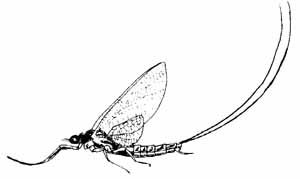 |
Figure 4.2 Taxonomic classification system Depending on the program, volunteers might be asked to identify macroinvertebrates to the order level in the field or to the family level if using microscopes in the laboratory. |
It is based on a protocol known as Streamwalk developed by the EPA Region 10 Office in Seattle, Washington, and is widely used by volunteers throughout the Pacific Northwest.
This tier is based on a protocol developed by the Ohio Department of Natural Resources and adapted by the Izaak Walton League of America. It has been used by volunteer monitors nationwide, including programs in Ohio, Tennessee, Georgia, Virginia, Kentucky, Illinois, and West Virginia.
Based primarily on EPA's Rapid Bioassessment Protocols, this approach has been adapted by Mary-land Save Our Streams, the River Watch Network and other groups.
| Protocol Elements | Stream Habitat Walk | Streamside Biosurvey | Intensive Biosurvey |
Table 4.1 Tiered framwork for volunteer biological monitoring programs Program designers might choose simple or complex approaches according to program goals and resources. |
| Program Objectives | ||||
| Complexity of Approach | ||||
| Resource Investment | ||||
| Training |
EPA Home | Office of Water | Search | Comments