The
Practical Observer
Measuring Double & Multiple Stars
The
Practical Observer
Measuring Double & Multiple Stars | |
|
|
|
|
The
Practical Observer
Measuring Double & Multiple Stars |
||
|
|||
|
|
|
Related Products
|
|
 The Chronometric Method for Measuring Double
& Multiple Stars
The Chronometric Method for Measuring Double
& Multiple Stars
sponsored by

|
The Chronometric Method for Measuring Double & Multiple Stars By William T. Geersten, Jr. Reprinted from The Practical Observer, vol. 9, no. 3. The Chronometric, or Transit, Method is apparently not well known in the United States. I discovered it in Ron Tanguay's "The Double Star Observers Handbook". After a couple of unsuccessful attempt at building a bifilar grating micrometer (the commercial models are far too expensive for my budget) and limited success with a diffraction grating micrometer under my light polluted skies, this looked like just what I needed. Best of all, I had all of the parts and pieces needed to make it work. Admittedly, I have not been using this method for very long, but the results, so far, are very encouraging, with accuracy well within 10% of published values for the stars measured to date. One word of warning, though. If you are a computerized "type-A" amateur astronomer who routinely observes hundreds of objects per night, double star measurement by any method is probably not for you. Care, patience and the desire for quality rather than quantity are essential for this kind of work.
Why Measure
Double Stars? How Does
the Chronometric Method Differ from Other Methods? There are five main advantages which are unique to the method. These are: 1) No calibration required. 2) 100% of the starlight reaches the eyepiece (as compared with 50% when a Diffraction Grating Micrometer (DFM) is used). 3) Low equipment cost. Slightly higher than the DFM but vastly lower than commercial Bifilar Micrometers (BFM). If you already have a stopwatch, a crosshair eyepiece and a scientific calculator, the cost can approach zero! 4) With care, a very high degree of accuracy can be achieved with equipment readily available to the average amateur astronomer. 5) No tiny micrometer spindle and numbers to read by red flashlight on cold nights!
What
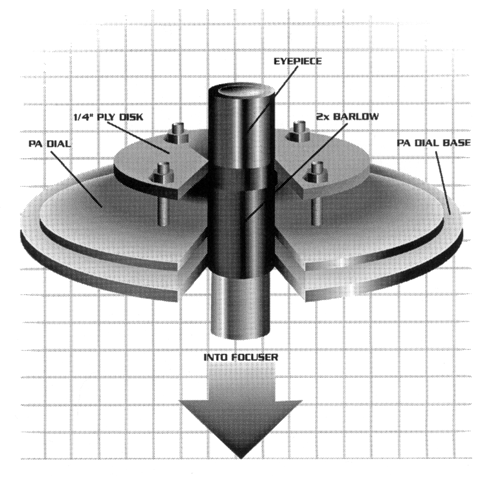
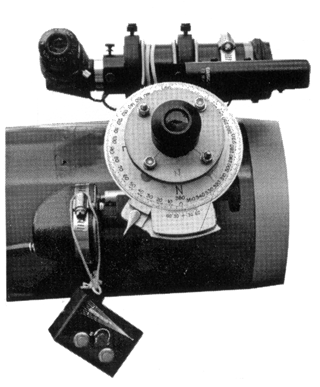
Equipment is Needed? An eyepiece fitted with crosshairs (illuminated if possible) is also needed. Mine came with my University Optics finder scope. You'll also need a stop-watch which reads to 0.01 seconds. I prefer an electronic watch with an LCD display because it is easier to read accurately with a red flashlight. Lastly, you'll need a scientific calculator. Mine is an old TI-58 with a red LED display, unaffected by cold temperatures, unlike LCD displays "old-tech" still has its place! The Position Angle Dial This instrument is built around a 1.25", 2x Celestron short barlow purchased at a star party. The short barlow allows the P.A. dial to be used with SCTs or refractors equipped with star diagonals. The P.A. dial was cannibalized from a K&E Paragon Drafting Machine found at a pawn shop for $5.00. It is a 5" engraved aluminum dial with an engraved vernier. It reads directly to 5 minutes of arc. The .25" ply disk is permanently fixed to the P.A. dial and has a 1.25" hole in the center. The hole is lined with thin felt to provide a snug but not tight fit for the eyepiece. The P.A. base and index mark are fixed to the barlow and can not rotate. The P.A. dial and .25" disk assembly is slip fit over the barlow and can rotate. The clamp provides two modes of operation: 1) P.A. dial clamped to the base; no rotation of P.A. dial. The eyepiece can be rotated in the 25" ply disk, independent of the P.A. dial, to align crosshairs North /South. 2) P.A. dial releases from base, 360 degree rotation, eyepiece rotates together with the P.A. dial to measure the position angle. The thumbscrew is removed from the 2x barlow. The eyepiece rotates independently in the plywood disk or in combination with the P.A. dial but is independent of the barlow. The barlow is held by the focuser thumbscrew and cannot rotate, neither can the P.A. dial base. Only the P.A. dial and eyepiece assembly can rotate. The index mark is part of the fixed base and is where the P.A. is read from the dial. The vernier is used to set the P.A. dial precisely to zero degrees and to read the P.A. to 5 minutes of arc. The small lever next to the vernier is the P.A. dial clamp. How is
Separation Determined from Transit Times? The equation used to convert transit time (t) into separation (S) is:
where S = separation, Q = position angle, t = transit time, i = incident angle, and d = declination of the star. If the position angle (43) is 0 to 180 degrees, the incident angle (i) is equal to 270 degrees - [(Q)+(45 degrees)]. All angles must be in decimal format.
The "Transit Computations" worksheet at the end of this article contains all the information you'll need in one place. It also contains a means of handling pairs with P.A.s within 10 degrees of due north (0 degrees) and due south (180 degrees) as mentioned above. What
Should I Do With All of This Data? In conclusion, I hope that this outline of how I have applied the "Chronometric" or transit method of measuring double stars spurs interest in others to give it a try. I am no expert, by any means and am open to suggestions shortcuts or anything that will lead to making the measurement of double stars easier and more accurate. The transit method and the diffraction grating micrometer are the least expensive methods I'm aware of for measuring double stars. Both use easily built instruments and are well-suited to small scope applications. In addition to individual efforts (such as my own), either method is well suited to astronomy club and astronomy laboratory projects. After making one or two measurements, the process becomes intuitive and enjoyable.
Copyright 2001 by Typographica Publishing, all rights reserved. |
|||||||||||||||||||||||||||||||||||||||||||||||||||||||||||||||