Society
for Amateur Scientists
Beginner's Corner
Society
for Amateur Scientists
Beginner's Corner | |
|
|
|
|
Society
for Amateur Scientists
Beginner's Corner |
||
|
|||
|
|
|
Related Products Society for Amateur Scientists
|
|

sponsored by

|
Beginner's
Corner
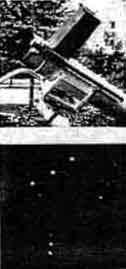
On this page are shown three amateurs' telescopes thus equipped. The first is a 6" reflector made by Charles E. Kratz, 3415 Copley Road, Baltimore, Md., who states that the camera is made of two telescoping wooden boxes, the stationary one curved to fit the tube to which it is fastened removably with hooks. The sliding part has a film holder or, alternatively, a ground glass focusing screen. (Anyone who has made his own mirror will know how to make ground glass, simply by brief abrasion with medium-sized abrasive grains.) Kratz' telescope is mounted on 3" pipe fittings and he says there is no shake.
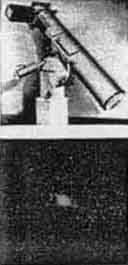
The second telescope is similarly equipped and, having a worm drive, can be used for photographing the stars as well as the Moon. A. R. Karnosh, 3296 Lansmer Road, Cleveland, Ohio, is the maker.
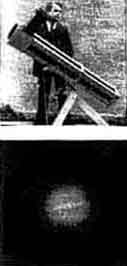
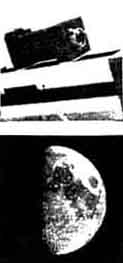
Third telescope is the work of R. M. Watrous, M.D. and Mrs. Watrous, and is the mate to the one shown here last month, though built a little more solidly. In the Watrous telescope the same box that is used for photographing the Moon by means of the telescope may be detached, remounted as shown in the fourth photograph, a lens added, also an end to hold it, and used for direct photography of the stars. Dr. Watrous states that he made this 2" lens from 1/4" common plate glass and, that, though there are striae in the glass and though it is, naturally, subject to every type of aberration a lens can have, nevertheless it will form images-of a sort. A photograph of a part of Orion, taken with it, is reproduced.
The two planetary photographs were made by H. A. Lower of San Diego, Calif., with more elaborate equipment but on the same simple principle. The first is of Saturn, exposure 30 seconds, the second of Jupiter exposure 15 seconds. Much original detail -most of it, in fact-has been lost in the half-tone process. The lunar photo was made by B. L. Bradley, 235 N. High St., Salem, Oregon, and is typical of many that have been sent this department. Unfortunately, the half-tone process reduces them all-good, bad and indifferent-to the same level of mediocrity but many of the originals received are very sharply defined.
|
 PHOTOGRAPHY
OF CELESTIAL objects, especially the Moon, is one of the simplest and
usually one of the first stunts performed by the builder of a telescope.
The book "Amateur Telescope Making" contains definite instructions for
doing it, and the equipment needed consists simply of the regular eyepiece
used in visual work, to which are added some kind of box and a simple
photographic plate.
PHOTOGRAPHY
OF CELESTIAL objects, especially the Moon, is one of the simplest and
usually one of the first stunts performed by the builder of a telescope.
The book "Amateur Telescope Making" contains definite instructions for
doing it, and the equipment needed consists simply of the regular eyepiece
used in visual work, to which are added some kind of box and a simple
photographic plate.