Society
for Amateur Scientists
Beginner's Corner
Society
for Amateur Scientists
Beginner's Corner | |
|
|
|
|
Society
for Amateur Scientists
Beginner's Corner |
||
|
|||
|
|
|
Related Products Society for Amateur Scientists
|
|

sponsored by

|
Beginner's
Corner
Admittedly, this is not the telescope the average person has in mind to make: not elaborate enough. To attain one's dream there are two ways. First, study the literature over and over, make numerous designs evolve a complete one, build it. Second, study the literature, make a simple design like that below, build it, use it for a few weeks or months, and then, in the light of actual experience (which inevitably brings to light numerous factors which no amount of mere study will reveal) design and make a telescope that will satisfy you. Those who choose the first course often say later: "I don't think so well of this design of mine as I thought I would, but I put too much work on it to discard it lightly now." For the preliminary telescope the Watrous typo is offered as an excellent solution.
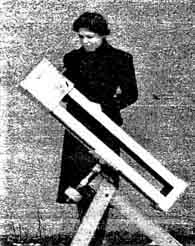
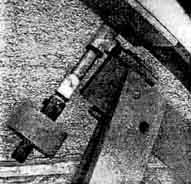
The axes are common pipe fittings. First, a T with long nip and pipe-nut is attached to the main leg of the tripod through a hole. This T, also the other T shown, is bored out internally-about a 50-cent machine shop job-to take the two stub shafts. (By another arrangement, sometimes used, the axes turn on the threads already on the fittings, but since pipe fittings have tapered threads, this usually results in annoying looseness). The lead counterweight is cast around a sleeve of larger pipe which is anchored with a set-screw. The square tube of the telescope is made of straight 1/2" stock, wood, two at each corner, edge nailed (better screwed) and is very rigid. Paint inside black. If near bright lights, enclose the lower 12" or so. Make main leg of tripod parallel the Earth s axis. Vary the details to suit your own taste Larger pipe fittings are suggested: Dr. Watrous himself mentions that the telescope shakes a little too much in a breeze.
|
 FROM
DAY TO DAY readers who have made telescopes from the instructions in the
book "Amateur Telescope Making'' kindly send in to this department descriptions
and photographs of them and, while lack of space prevents publication
of more than a very few, they are all closely studied here under a reading
glass, and all details noted. The one shown below struck this department
as perhaps being one good solution of the beginner's problem of choosing
a type of mounting for his first instrument. It is simple to build, inexpensive,
efficient, portable, yet it is neat and trim. This is one of two similar
telescopes made by R. M. Watrous, M.D., 2027 Noyes St., Evanston, Ill.,
and Mrs. Watrous.
FROM
DAY TO DAY readers who have made telescopes from the instructions in the
book "Amateur Telescope Making'' kindly send in to this department descriptions
and photographs of them and, while lack of space prevents publication
of more than a very few, they are all closely studied here under a reading
glass, and all details noted. The one shown below struck this department
as perhaps being one good solution of the beginner's problem of choosing
a type of mounting for his first instrument. It is simple to build, inexpensive,
efficient, portable, yet it is neat and trim. This is one of two similar
telescopes made by R. M. Watrous, M.D., 2027 Noyes St., Evanston, Ill.,
and Mrs. Watrous.