Astronomical
Society of the Pacific
The Unspeakable Act of Creation
Astronomical
Society of the Pacific
The Unspeakable Act of Creation | |
|
|
|
|
Astronomical
Society of the Pacific
The Unspeakable Act of Creation |
||
|
|||
|
|
|
Related Products Astronomical Society of the Pacific
|
|
 The Unspeakable Act of Creation
sponsored by

|
The Unspeakable
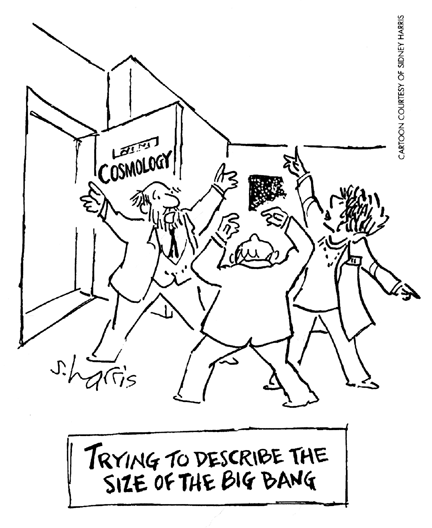
Act of Creation Divining the nature of the universe takes great intelligence, a little wit, and, uh, other special qualities. by Chris Impey Reprinted from Mercury, Mar.-Apr. 1998. We are at Princeton University to debate cosmology. Cosmology is the study of you, me, our Galaxy, and the hundreds of billions of other galaxies flung out there like crumbs on black velvet. Cosmology is voyeurism. Our noses are pressed against the window of creation, trying to get a glimpse of the action. Singular and violent events have taken place. Who, then, are these people who study cosmology? They are like you and I. The meeting auditorium is a sea of mostly white, mostly male faces: fashion by discount department stores, a riot of checks and plaids and Madras shirts, the odd shiny-elbowed jacket. Hair care is not a concern. The bodies are as God and nature intended–no tattoos, nipples unpierced. Like breakfast cereal, some settling of the contents has occurred over time. Gravity has spoken in the spreading rump of the professoriat. It could be a sales blitz for time-share condos or products for male-pattern baldness.
They are not like you or I. They are comfortable with the runes and glyphs of mathematics, and they know the guilty pleasure of differentiation under the integral sign. They are facile with computers, the amber flicker of bits dropping into place more comforting than a warm fire. A closer look reveals other differences. Bright eyes are framed by dark-rimmed glasses and set against skin pallid from too much seclusion in the seminar and symposium. Domed heads have smooth planes that seem to have been hammered from within by relentless intelligence. Sprawls of facial hair emerge in a kind of inverted symmetry. These are the chosen, the individuals entrusted with cobbling together a picture of the universe and telling the fable of universal creation. We
know what the universe is like. Most of space is inky, empty void. The thin gruel of stars provides the only warmth, so here we are like bums on a construction site at night, huddled around a fire. As Camus said, you can open your heart to the benign indifference of the universe, or drown in existential angst. The participants at the Princeton meeting may not have mastered the fine arts of color coordination or personal hygiene, but they know the night sweats of thinking about our place in the scheme of things. They have wrestled with the ignominy problem. In spite of their struggle, cosmologists have come up with a creation story, and it's a real white-knuckler. Every culture gets the creation myth it deserves, and ours is a story of stealthy universal expansion, of dark matter and implacable forces, of grand structures emerging from the gloom. The universe's expansion points to a time long ago when all matter was crushed in a gravitational vice called the Big Bang. Next time you are on a bus or a train, look at your neighbor. You may not care to brush against an elbow or a leg, but fifteen billion years ago your atoms and theirs were mixed in the cauldron of creation. Every particle of your being in a roiling stew with the particles of every other person on the planet. A shocking intimacy. Like any voyeuristic science, cosmology is tentative and uncertain, but the Big Bang is real. We are bathed in microwaves from creation. The early, intense radiation has diluted with universal expansion like hot kettle water poured in a cool bath. Tune your TV to an empty channel, and one percent of the specks on the flickering screen are set off by the microwaves from the first instant of the universe. But what are we to do with this information? What good does it do us to know of the countless assaults on our atoms, of our carbon that was burped out by bloated red giants, of our metals that surfed the blastwave of a supernova? These are our unspeakable origins. You can stop reading now, or continue as we follow the high priests of cosmology on their Faustian quest for our origins. "We
are gathered together to..." Next come the observers. They descend bleary-eyed from mountaintops clutching finding charts and data tapes. Under cover of darkness, they gather photons from far-flung, alien shores. Sources of radiation are counted and cataloged. Pity the observers as their photons streak through billions of years of time and space, stretching lazily with universal expansion, only to be caught by a cloud in Earth's night sky or to fall uselessly to the floor beside the telescope. We also find here a small cadre of particle theorists. Their universe is an accelerator far bigger than man or magnet can provide. In the hierarchy of science, they are the most macho. It's a lonely life, to be stuck between the very large and the very small. So occasionally they stumble in from the wilderness to deal distractedly with the icons of everyday life–the VCR, the shopping list, the toaster. the festivities begin The first speaker is Gawain Rhys. An elfish man with a thatch of silvery hair, he grips the podium and delivers the ecumenium. Cosmology has a standard model, a stripped-down, no-options package, and Rhys places odds on whether or not we have right–the drive-train, the brakes, the headlights. He has a rakish nose under surprisingly gentle eyes, and his soft, reassuring voice has the cadence of a West Country preacher. It's funny how often the religious metaphor comes up. Rhys refers to his own sermon. Others talk of the true believers of this or that cosmology and of preaching to the choir in favor of some shopworn model. When ripples were first detected in the glassy sea of microwave photons from the Big Bang–the precursors of stars and galaxies and you and me–scientists coyly labeled them the fingerprints of God. The galaxies that stretch away from us in tendrils through space are called fingers of God. Other body parts will be named before the week is out. God is a cozy co-conspirator, smiling benignly on the proceedings. This is all vagueIy discomforting. We have been brought up to believe that wielders of the genesplicer and the cyclotron should have no truck with the spiritual arts (see "Heavenly Conflicts"), yet perhaps the self-conscious nods to religion are natural in a subject where we can answer the How but not the Why. It's touching that people who manipulate the equations of General Relativity for a living can be frightened of things that go bump in the night. Is this a premonition of a time when all scientists must stand naked before death and God, shorn of theory and corollary?
Next up is the debate on the universe's size. To astronomers' chagrin, the expansion rate and size of the universe are uncertain by about 50%. A change in the prime lending rate would have more impact on everyday lives, but to astronomers this uncertainty is a rift of Sisyphean proportions. Heidi Perrance, oozing confidence and competence, speaks for a smaller, younger universe that expands quickIy. She breezes through her business-like presentation, ending in a blur of viewgraphs. Heinz Althof follows, a genial old Swiss in a linen jacket who argues for a larger, older universe with a slower expansion. The emcee for the debate is Herb Bronski, a youthful university professor with a twinkle in his eye. He teases and cajoles the protagonists, milking the audience for laughs. The faster expansion rate gives an age that is at odds with the calculated ages of the oldest stars. Rule one: the universe cannot be younger than the oldest objects it contains. Bishop Ussher once added Old Testament begats to peg Genesis at 5:00 pm on 23 October in the year 4004 B.C. Now that's way too young. Steve McMarsh, a slab of a man with puckish ginger hair, is reassuring about this potential fly in the ointment. There is no age problem, he opines. things get technical The detailed health of the Big Bang is poked and prodded. Next time you throw a kid's party, thank the Big Bang. Most helium was brewed up in the first three minutes, along with a dusting of heavy hydrogen, or deuterium. The balloon tugs lightly at your arm, yearning for its origins. But what else was formed in that ancient brilliance? Something dark? Cosmologists live in a shadowy world, tugged by the unseen heft of dark matter. A keenly anticipated debate at the Princeton meeting hones in on whether or not there is enough dark matter to overcome the Hubble expansion. If so, the universe will creep to a halt billions of years from now, breathe a cosmic sigh, and start a slow plunge towards the Big Crunch. If not, all galaxies will sail on apart, but within them the stars will blink out one by one, their fuel exhausted. Galaxies will fade to leave a Cheshire cat grin of black holes and white dwarfs. This debate turns into a battle of the mesomorphs. Anton Pettig holds for a closed universe, while Rex Asumai holds for one ajar. Asumai is one of the warriors who mapped out large structures and voids in space, but here he sits peeved as Pettig dominates the debate. Victory, however, ultimately goes to Asumai, his opponent Pettig a whale beached by fact and fashion on the shores of a hefty universe. And in this high-density universe, assuming for the time that battle victory means the war is won, what's moving and what's not? This has bugged cosmologists ever since Einstein imagined how the world would look as he rode a beam of light into the garden of relativity. The universe itself is not moving (where would it go?), so we define all motion with respect to the microwave background radiation. Cosmologists hope and presume that a set of galaxies far enough away will show no overall motion through the microwaves, but is this the view from aboard our Earthy ship? As poet Archibald MacLeish realized, we do not lay the dead to rest. Instead, their bones describe an arcing helix as we spin and orbit the Sun. The ship is lurching; we grip the railing. The Sun moves sedately around the Milky Way every quarter of a billion years. The Milky Way falls toward the Andromeda galaxy, and both are tumbling towards the Virgo supercluster of galaxies, some 60 million lightyears away. Virgo galaxies are all streaming toward an even larger concentration of matter in the direction of the Hydra and Centaurus constellations. We vainly try to find a fixed horizon on the heaving ship, but even the distant seas are tilting and sliding. Some studies have taken the census of galaxies out to several hundred million lightyears and still not found a cure for motion sickness. If the universe is really a giant Tilt-a-Whirl, it is-bad news for conventional cosmology. Gravity should not be able to cause such extravagant motions, which astronomers call bulk flows (see "Digging for Clues to Galaxy Formation in Large-Scale Structures"). Theorists speculate that the data are faulty: "Those observers screw up sometimes." Observers, well, they relish the chance to maul a cherished theory. The
brain is a gland The socialization may be imperceptible to the outsider in this meritocracy of intellects, but there are rules in the cosmology club. It's okay to be arrogant as long as you're really smart. It's definitely okay to work on a theory so fundamental that it might never be tested. It's okay to use a supercomputer, but it's better to use the back of an envelope. And it's okay to be wrong as long as your analysis is elegant. The worst fate is to be labeled a technician: someone who is handy with a second order differential equation but lacks big-picture skills. By symmetry, it's best to have a single brilliant idea that attracts legions of bright young minds to work out the details. "Look, I drew an enigmatic smile and signed the corner of the canvas. You fill in the rest; it's the Mona Lisa." Many of the stereotypes are true. It is hard to imagine a group more otherworldly and less worldly. Abstraction is the mantle that keeps the awkward emotions of the world at bay. At this conference, there are no references to the popular culture. Some speakers may quote Leucretius and Blake, but poetry stops with Eliot, music with Mozart. Most of us are holed up in the Princeton student dorms, and on the first morning there is the bizarre sight of cosmologists—who finesse the first microsecond of the Big Bang—milling around helplessly trying to figure out the self-service cafeteria. These are heirs to Archimedes, who ran dripping and naked through the streets with the adulterated crown, and Newton, who would abandon his dinner guests to finish a calculation he chanced on at his desk. we nudge closer to the Big Bang Walter Moecker talks later in the week about the quantum processes that might have spawned the universe, born from a single bubble of seething space-time foam. Moecker won his Nobel Prize for unifying two of the four forces of nature, and he speaks with the resoluteness of someone who knows there is still work to be done. The delivery is magisterial. In sonorous tones he explains that different pockets of space-time can coexist at creation, each with the potential to be a universe with unique properties. Welcome to the multiverse. Next, Gavin Thug describes inflation. This is the iota of time when the budding universe rapidly unfolded from the size of a proton to the size of a grapefruit, and then continued expanding to become as big and smooth and empty as we observe today. Inflation is a Big Idea, a part of the standard vanilla cosmology since 1981. It means that we only see a part of the Whole Universal Enchilada: We can see only that part of the universe from which we've been able to receive light since the Big Bang, and that makes the most remote objects about 12 billion lightyears away. Thus, every day our universe gets a light-day bigger. The universe may be cut from a very large bolt of cloth, and the warp and weft of the patch we see may not reflect the whole. Perhaps we're a sober square of deep blue in a raucous tartan. cosmic ball of yarn You lose your grip if you stay in the auditorium too long. Trips outside are needed to spritz the senses and remind you that daily affairs in the "real world" continue as we consider the Origin and Fate of the universe. Inside it's a collection of cosmologists through the week. Patrician Yankees, inner-city Jews, Russian emigres, sibilant Brits, fastidious Poles, all dealing mostly with vanilla cosmology, a Big Bang seeded with cold, or slowly moving, dark matter. But more exotic flavors exist and some Young Turks like to form their galaxies from topological defects – magnetic monopoles, strings, and domain walls, fissures in the otherwise smooth universal fabric. You can see them coming. You'd walk funny, too, if you had a crease in your space-time.
The magic moment of creation, however, belongs to the theorists who toil with superstrings and membranes and super-symmetry. Forget your quaint notions of proton or neutron point particles. These magicians conjure all matter and energy from interactions of terribly tiny membranes which, if rolled tightly enough, give multi-dimensional, wiggling strings that dance and flex like rubber bands, splitting, merging, and vibrating. The forces of nature emerge from a 10- or 11-dimensional space-time (what's a dimension among friends?), where the extra dimensions were long ago wadded up into an infinitesimally small ball, leaving us with the four we know and love. "Honey, I'm off to work on the compactification of space-time." This is quite a mathematical chore, but possibly worth it because these membrane theorists might just be stumbling into a view of the material world in which relativity, the big, and quantum mechanics, the small, meet in an obscene yet longed-for union. Only superheroes and these stringy, membrane theorists wear their underpants on the outside. The
Zaniest Idea of All Perhaps the universe is made for us. And perhaps many others, crazily different from ours, were also created or are still being created from space-time foam. Maybe some are just slightly different, like ours only there's no TV, or gravity really is stronger in the mornings. Some may be wildly different, where time can flow backward. Each morning you regurgitate the egg, whip it back into its shell, and stuff it back in the chicken (that's all I'll say about that). Some may be unrecognizable, with life based on magnetic fields and gender as the charge on a spinning particle. Proposing multiple universes does not make it any less remarkable, however, that we live in one where the bed's just right and the porridge is salted to our taste. Scientists have been jawing cosmology on staid and leafy campuses since Plato founded the Academy in an olive grove outside Athens. Yet sometimes the zest is lost in the drear of scientific prose and a thicket of equations. Science is incremental, and many dull bricks have to be placed to make an elegant wall. What is apparently missing from our musings sometimes is the spice of humanity. After all, there's magic in the fact that humans can romance the universe of which they are a part. It is hard not to admire the jaunty arrogance displayed by cosmologists at the conference, but the long view of history says that we have much to learn about our universe. This is not like peeling back layers in an onion of knowledge to the kernel of truth within. This is the lurching progress of a drunkard who spends one day in a fog, and in the next experiences a crystal moment. We've been heading toward this moment with no reason to hurry because the journey is so much fun. Ever since creatures crawled from the oceans and grew spines and brains and thumbs. Ever since our ancestors roamed around on the plains of Africa trying to do the tool thing. Ever since we tilted our heads to the night sky and felt the hair stand up on our necks. CHRIS IMPEY (cimpey@as.arizona.edu) is a Distinguished Professor of Astronomy at the University of Arizona. He is relatively well-socialized, for a scientist, and he thinks a lot about earthly things and cosmology. An unexpurgated version of this article is available from him via email. Copyright 1998, 2001 by Astronomical Society of the Pacific, all rights reserved. |