Society
for Amateur Scientists
Cultivation of Bacteria
Society
for Amateur Scientists
Cultivation of Bacteria| |
|
|
|
|
Society
for Amateur Scientists
Cultivation of Bacteria |
||
|
|||
|
|
|
Related Products: Society for Amateur Scientists
|
 Sponsored by:

|
Techniques in Microbiology: Cultivation of Bacteria on Laboratory Media Source: World Health Organization Inoculation of Culture Media For microbiological investigations it is essential to learn the skills of inoculating specimens onto culture media and subculturing from one medium to another. Instrument for seeding media This is selected according to the nature of the medium and inoculum. Platinum or nichrome wires of different gauges are used. Nichrome has oxidizing properties and hence in some of the tests where this property of bacterium is to be tested (e.g. oxidase test), platinum wire, instead of nichrome should be used. This wire is sterilized by holding it vertically in the flame of the burner so that the whole length of wire becomes red hot. It is allowed to cool down before it touches any material suspected to be having bacteria to avoid the heat killing the organisms. Presterilized disposable loops are now available commercially. The wire can be used as a:
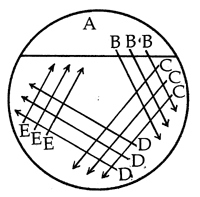
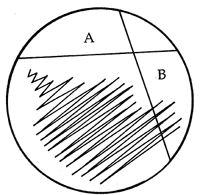
Seeding a culture plate There are three commonly employed techniques for seeding culture plates. The most common is shown in Fig. 1. The inoculum from the clinical material or another plate is first spread out in the form of a primary inoculum (as at A in Fig 1) which is also called as ‘well-inoculum’ or only ‘well’. The successive series of strokes B, C, D and E are made with the loop sterilized between each sequence. At each step the inoculum is derived from the most distal part of the immediately preceding strokes so as to gradually reduce the number of bacteria. This helps in obtaining isolated colonies. In an alternative plating procedure one edge of a large loop is used to make a secondary well (see B in Fig 1). The other edge is then used to make succession of strokes across the remaining unseeded area. When the inoculum is small or the medium is selective it can be more heavily inoculated (Fig 2). Several loop-fulls of the specimen are used to spread the primary inoculum (see A in Fig 2). After sterilizing the loop, it is recharged by rubbing it over area A and the plate is seeded in parallel strokes.
Seeding a liquid medium If the tubes have got cotton plugs, the mouth of the tubes should be heated in flame before and after any handling of tube to prevent contamination from the rims of tubes getting into the medium. It is not required when metal caps and screw-capped tubes are handled. Incline the tube containing the liquid medium to 45° and deposit the inoculum on its wall above the surface of the liquid at its lower end. Return the tube to a vertical position. Now the inoculum shall be below the surface of the liquid. Subculture from a solid medium to solid medium
Inoculation of carbohydrate fermentation media These are inoculated as liquid media and incubated at 37° for 18-24 hours. When the particular sugar is fermented, acid is produced which changes the pH of the medium thus turning phenol red into yellow. In case the fermentation is with the production of gas, a bubble of air is visible in Durham tube. Seeding solid media in test tubes Slopes of solid media are inoculated by streaking the surface of the agar with loop in a zig zag manner. Stab cultures are inoculated by plunging the wire into the centre of the medium. Aerobic Incubation of cultures For bacteria of medical importance, incubation is uniformally done at 37°C. Depending upon the workload a laboratory may have a tabletop incubator (suitable for peripheral laboratories) or a walk-in incubator. For prolonged incubations, as are required for the growth of Mycobacterium tuberculosis, screw-capped bottles should be used instead of petri dishes or tubes to prevent the drying of medium. Incubation in an atmosphere with added carbon dioxide Extra carbon dioxide is needed for optimal growth of organisms such as Brucella abortus, pneumococci and gonococci. The concentration of additional carbon dioxide needed is 5-10 per cent. The simplest method for having this environment is to put the plates in a container and generate CO2 inside by lighting a candle in it just before putting on the lid. Pure CO2 can also be introduced in a container. Carbon dioxide-generating kits are now available and so are incubators which can provide a predetermined and regulated amount of this gas. Special CO2 incubators (also called capnoeic incubators) are available commercially. Aseptic techniques Aseptic techniques are important to protect the worker from infection from the clinical specimen and also to prevent contamination of the material under process. Aseptic conditions can be achieved by following steps:
Further reading 1. Isenberg HD(Ed) Clinical Microbiology Procedures handbook. American Society for Microbiology, Washington, DC, Vol 1, Section 1.4, 1992. 2. Collins CH, Lyne PM and Grange JM. Microbiological Methods. Butterworths, London, 94-96, 1995. 3. PHLS Standard Operating Procedures — Inoculation of culture media No B.SOP 54 Version:1, 1998. Reprinted from:
|