Society
for Amateur Scientists
Building the Variable Power Supply
Society
for Amateur Scientists
Building the Variable Power Supply | |
|
|
|
|
Society
for Amateur Scientists
Building the Variable Power Supply |
||
|
|||
|
|
|
Related Products: Society for Amateur Scientists
|
 Sponsored by:

Building the Variable Power Supplyby Paul Dito A fundamental tool for prototyping circuits is the variable power supply. While you can use batteries to power your circuit, it is usually much easier to use a line powered bench supply. Having a known, constant voltage is essential for development. Analog circuits often need a negative voltage to properly process signals near or below ground, therefore it is also useful to have a split or dual power supply. Other desirable features include panel meters, so you can see the voltage and current draw with a glance, and a fixed 5 volt output for power digital circuits. Building your own power supply is also a very good introduction to building prototypes. It is relatively easy to build a supply, even if you have limited tools, and you get a useful piece of test equipment when you’re done.
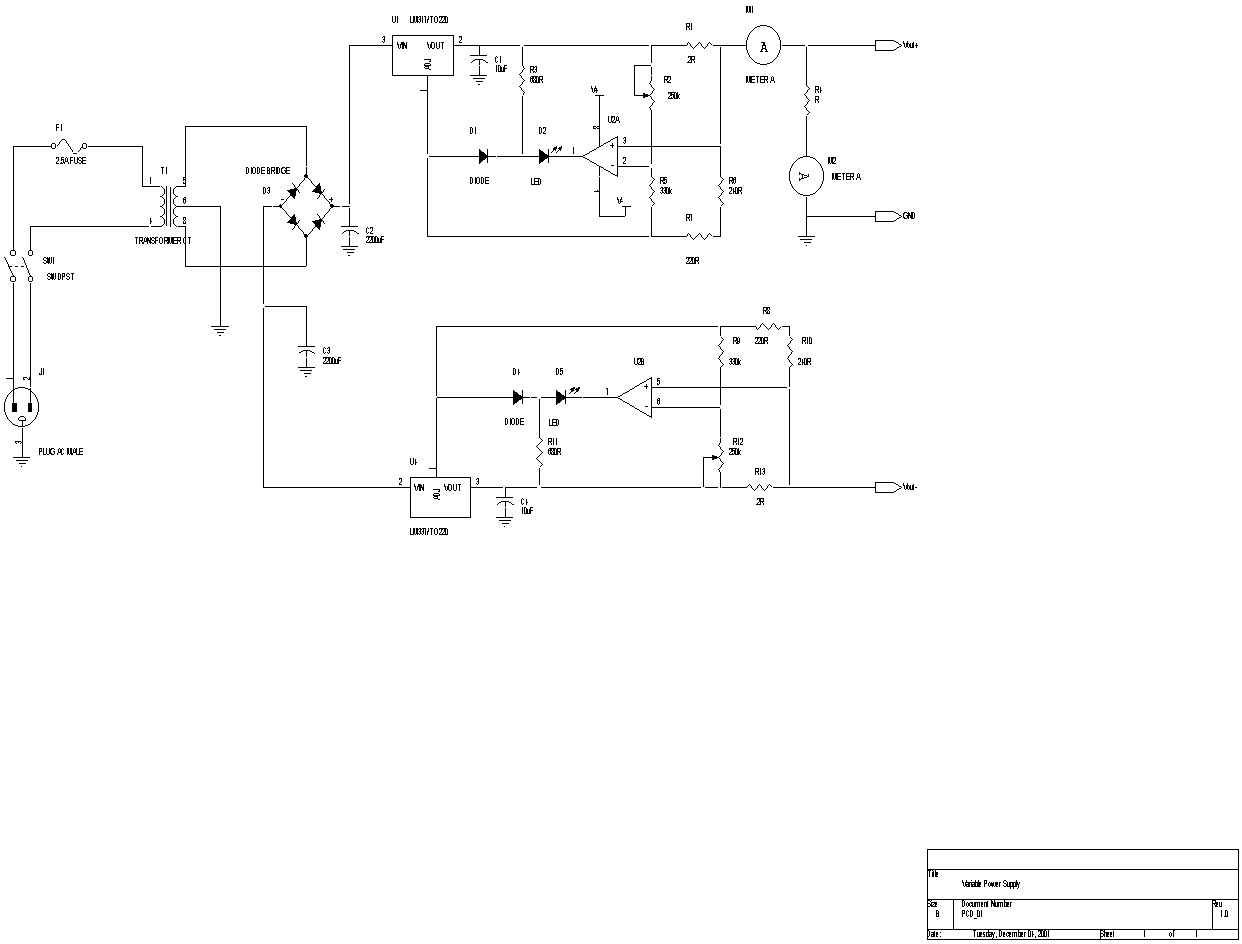
Circuit Description The circuit is based on the time-tested LM317 voltage regulator. Using the LM317 and just two resistors you can regulate any voltage from 1.2 to 25 volts. Make one of the resistors a potentiometer and you have a variable output voltage supply. This particular design limited to a maximum of +-12 volts. While it can be useful to have two completely separate output voltages, that would require two transformers and adds to the cost, size and complexity of the circuit. This design uses a simple split supply meaning one side of the variable supply is always positive, while the other side is negative, relative to ground. Two panel meters are used to monitor voltage and current. The two meters are shared between the positive and negative outputs for cost and space considerations. A double pole double throw switch is used to change between the supplies.
Bill of Materials Most of the components for the variable power supply are readily available, but a few items require further explanation. First, the potentiometers should be two dual ganged units. This will make the output voltages track, i.e. the positive and negative supply will always be equal. You can use two separate pots if you can’t find the ganged version, or you want to control the voltages separately.
Next, the panel meters need some consideration. The resistances listed on the schematic are calculated for the 1 mA meters listed in the bill of materials, so if you make any substitutions you will need to recalculate their values. The specified meters were chosen for their small cost and size. Construction Begin by laying out the enclosure. Choose locations to mount the transformer and circuit board. Locate the meters, indicators, outputs, and controls for the front panel. Locate holes for the power cord and fuse holder. Drill all holes and mount the front panel components (easier said than done, right?). I don’t have a punch to make the holes for the panel meters, so I had to use a nibbling tool. Mount the transformer and fuse holder. Insert the power cord and connect to the switch and fuse holder. Connect the ground wire of the power cord to the chassis. Stuff the circuit board according to the schematic. When I’m building a prototype, I like to have a copy of the schematic that I mark up as I go along. I use a highlighter to indicate the components and connections I have made. Generally when I’m building a prototype I try to construct the circuit along the signal path. It’s also convenient to hold the circuit board in some sort of vice or clamp as you work. Make sure you leave plenty of room around the regulators (U1, U2, and U3) for mounting the heat sinks. These help dissipate heat and allow the regulators to deliver maximum current. Solder the leads from the transformer to the diode rectifier (D1) on the circuit board. Using stranded hookup wire, connect the controls (the SW1, SW2 and potentiometers) and carefully observing polarities, connect the front panel indicators (D2, M1, and M2). Mount the circuit board to the chassis using standoffs and double check all wiring. Power on the unit and check the panel meters. The voltage meter should jump up, while the ammeter stays low. If the ammeter shows any significant value, turn off the power and check all connections again. If all looks well, attach a multimeter to the outputs and measure the voltages. Adjust the voltage and confirm the voltage varies from 1.2 volts to 12 volts on each supply. Fit the knobs and feet and close up the chassis. Troubleshooting Most of the design should be straightforward. Any trouble is likely associated with wiring errors. If all looks well, use a multimeter and carefully trace the voltages through the circuit. Start with the AC line voltage after the fuse, and at the input to the transformer You should measure more than 110 volts AC. Check the output of the transformer, then the output of the diode bridge. Measure the voltage at the inputs to the regulators and after. Application While this is a serviceable
power supply, there are some caveats. Each regulator can deliver up to
about an amp, the transformer is only rated for 2 amps, so keep the current
draw from each output to less than 500 mA if using all three. Also, be
careful of high current at low voltage through the adjustable supply.
A large voltage drop at high current will quickly overload the regulator.
The power dissipated by the regulator equals the voltage drop across it
times the current through it (P=IR).
Reprinted from:
|
|||||||||||||||||||||||||||||||||||||||||||||||||||||||||||||||||||||||||||||||||||||||||