Society
for Amateur Scientists
The "Plumber's Special" Sorption Pump
Society
for Amateur Scientists
The "Plumber's Special" Sorption Pump | |
|
|
|
|
Society
for Amateur Scientists
The "Plumber's Special" Sorption Pump |
||
|
|||
|
|
|
Related Products: Society for Amateur Scientists
|
 Sponsored by:

The "Plumber's Special" Sorption Pumpby Roy Schmaus This project was inspired by Shawn Carlson's article 'Working in a Vacuum' from the October,1996 issue of the Scientific American magazine. I have been trying bits and pieces of the project as time and resources permit, so far have only made a different version of the Sorption pump. You'll never do E-beam evaporation with it, but some other interesting experiments should be possible. Some brazing skills are required, alternately a local welding shop may braze the pieces together for you.
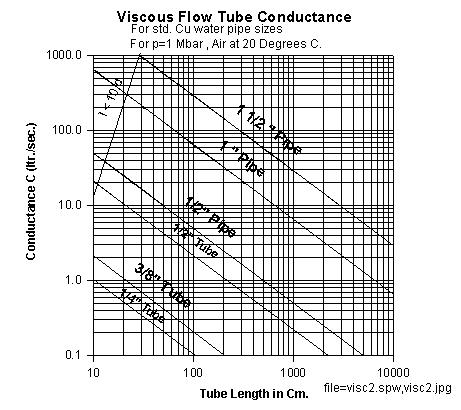
We have an old Varian 'Vacsorb'® sorption pump in the lab,after studying the manual for it I decided that an all metal pump would be fairly easy to fabricate and have a number of advantages over glass. Varian's manual mentions the poor thermal conductivity of the sieve material, their pump in fact uses a system of internal cooling fins and screens to ensure good thermal contact with the LN2 with good vacuum access to the molecular sieve. The manual also warns against using activated charcoal, since charcoal and oxygen can be explosive. Our pump is esentially a tiny 'model' of the Varian pump, but without the internal cooling fins and pumping screens and with copper substituted for the aluminum pump body. Inlet pipe size is a compromise, since pumping speed increases four-fold each time the diameter of the pumping line is doubled but unfortunately the price of compression fittings also increases with size. The Pipe Conductance Nomogram (below, right) shows the advantages of increasing pumping line size of lines longer than 10X diameter.
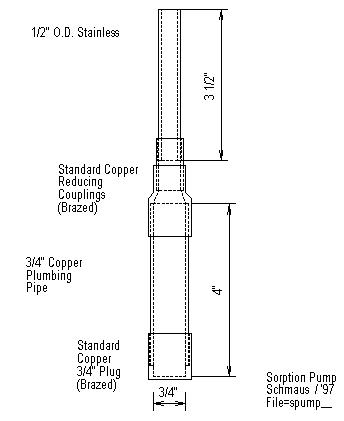
The pump was fabricated out of a four inch length of standard copper water pipe with a pipe cap brazed to the bottom end. The top (inlet) end was fitted with reducing couplings brazed between the 3/4 inch pipe and a length of 1/2 inch O.D. stainless steel inlet tube. Stainless steel was used here because of the low thermal conductivity necessary for a thermal gradient between the cold copper and the room temperature system at the tube's inlet end. Cleaning after brazing was a major problem.Hot water and soap were used initially to remove the brazing flux. Chemical cleaning was required to remove the crud from the copper so it was dunked in a container of heated Ammonium Persulphate etchant, then thoroughly rinsed and dried. The pump was then mounted on a lab stand, held by a clamp on the stainless steel section. The pump was then filled with 30 cc. of 5 Angstrom Molecular Sieve material. Type 5A . The 5A refers to the diameter of the pores. Note that type 4A can't be used to pump air because it's pores are too small to admit the nitrogen molecule at liquid nitrogen temperature. Use the 1/16 inch size, you do have to funnel the stuff down the inside of a 1/2" O.D. tube.
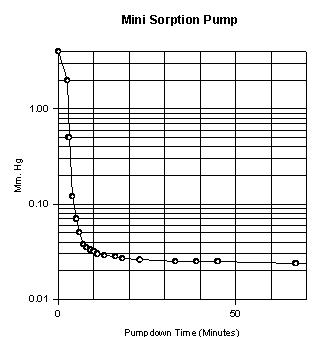
The next step was baking to release the trapped water vapour,etc. from the Molecular Sieve. A small cartridge heater (Watlow G4AX158) was clamped to the side , a type J thermocouple attached to my 'home-brew' oven controller was dropped down into the sieve material, and the temperature of the unit was raised in stages to 250 degrees C. Steam started to rise out of the inlet at around 240 degrees,it stopped after about 1/2 hour so the heat was then turned off and the pump was allowed to cool to room temperature with a simple rubber stopper in the inlet. A Pirani gauge was then fitted
to the pump inlet with compression fittings and the pump was cooled in
liquid nitrogen. Results are above.
References
Reprinted from:
|