Society
for Amateur Scientists
A Simple Pipette and a Vacuum Filter
Society
for Amateur Scientists
A Simple Pipette and a Vacuum Filter | |
|
|
|
|
Society
for Amateur Scientists
A Simple Pipette and a Vacuum Filter |
||
|
|||
|
|
|
Related Products: Society for Amateur Scientists
|
 Sponsored by:

A Simple Pipette and a Vacuum Filterby Sidney Gernsback
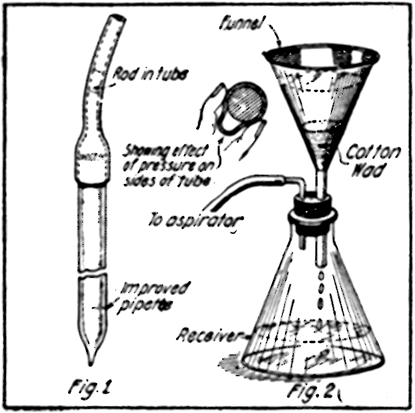
There are many instruments and opera-tions in chemistry that can be so improved as to make them handier or to shorten the time required for a given process. Many of these are in everyday use in large laboratories but the experimenter hears but little of them. A form of burette, or more properly a pipette, having several advantages is shown in Fig. 1. Instead of the usual form with the stop-cock at the bottom, a plain graduated tube is fitted at the top with a 6-inch length of rubber tubing. The valve in this case is made by sliding a short length of glass rod into the rubber tube, locating the same midway of its length. The tube is normally kept closed by this rod but a slight pressure on one side of the rubber will cause the tube to buckle out and form a channel through which liquids or air can flow. The device can be filled either by sucking the fluid up into the tube with the mouth or by immersing it into the fluid with the valve open and removing after the valve is closed. This valve will give a finer regulation of the discharge than the usual stop-cock, a drop at a time or a steady stream being readily attainable. Vacuum Filter When filtering thick fluids the process may be speeded up by the use of a vacuum filtering device. To create the vacuum, use can be made of the glass aspirators which are procurable at a very reasonable price. To use this for filtering, the receiver is fitted with a cork having two holes. One, large enough to take the spout of the funnel, the other having a short glass tube inserted. See Fig. 2. A wad of absorbent cotton is
placed in the bottom of the funnel and reaching a short distance up the
sides. This is to support the filter paper and prevent it breaking under
air pressure. The bent glass tube is connected to the aspirator and when
the water flow is started a slight vacuum will exist in the receiver.
Any liquid poured into the funnel will be filtered at a rapid rate due
to the air pressure forcing it through.) Reprinted from:
|