Society
for Amateur Scientists
Measuring Volume of Liquids with a Pipet
Society
for Amateur Scientists
Measuring Volume of Liquids with a Pipet| |
|
|
|
|
Society
for Amateur Scientists
Measuring Volume of Liquids with a Pipet |
||
|
|||
|
|
|
Related Products: Society for Amateur Scientists
|
 Sponsored by:

|
Measuring the Volume of a Liquid with a Pipet Adapted from
"Science Lab Techniques"
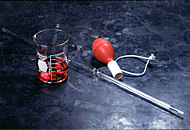
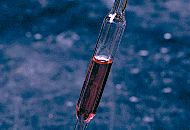
Pipets are much more accurate for measuring the volume of a liquid than graduated cylindars. Reading the volume in a pipet is just like reading a graduated cylinder, however using a pipet involves some additional technique. The diameter does not allow a liquid to be poured into a pipet - the liquid must be drawn in by suction created by a standard pipet bulb.
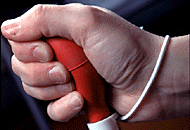
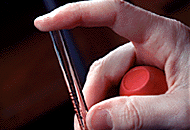
Much of the "professional" lab work today is done with automatic pipets. These are expensive little gadgets that come in many different volumes, each delivering exactly its assigned volume with one click of a button. Those of us who don't have access to such gear need to know the basic techniques of pipetting, which uses glass pipets and a standard pipet bulb. The standard pipet bulb requires manual dexterity that improves with practice. It may take a few tries before you can accurately transfer a measured volume of liquid. Here's how it works:
Reprinted from:
|