Astronomical
Society of the Pacific
Stargazing Secrets of Kitt Peak
Astronomical
Society of the Pacific
Stargazing Secrets of Kitt Peak | |
|
|
|
|
Astronomical
Society of the Pacific
Stargazing Secrets of Kitt Peak |
||
|
|||
|
|
|
Related Products Astronomical Society of the Pacific
|
|
 Stargazing Secrets of Kitt Peak
sponsored by

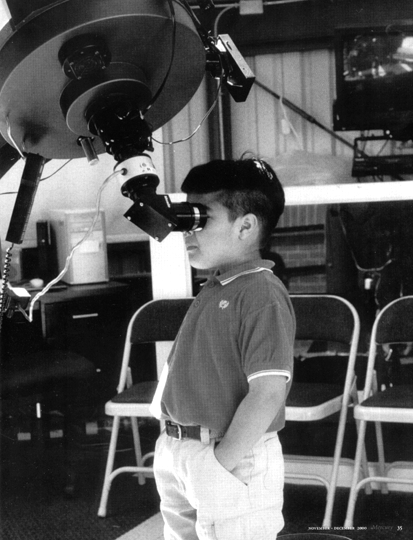
Stargazing Secrets of Kitt Peakby Steven W. White I get paid to show people Saturn in a telescope. I get to watch people's eyes light up and hear them say, "Wow!" I get to see misconceptions dispelled after a lifetime of comfortable, unchallenged residence. I get to plant the seed of curiosity in the minds of children. Sometimes, I get to see normal people transform into amateur astronomers.
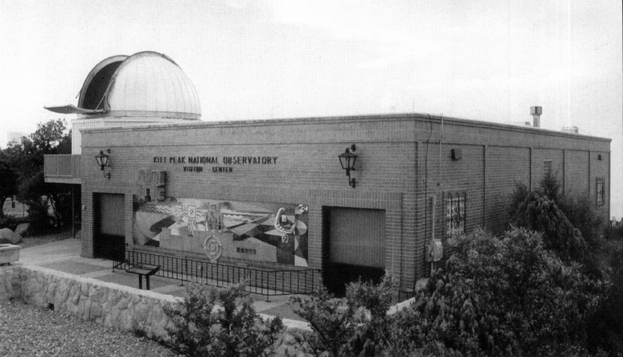
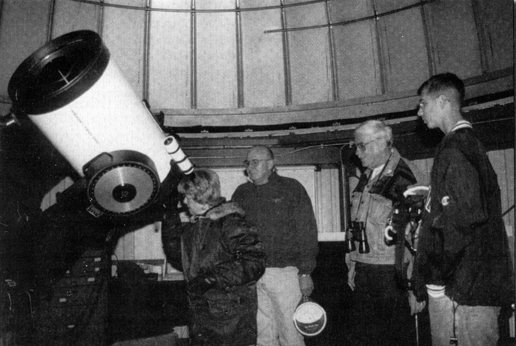
At the Kitt Peak Visitor Center in southern Arizona, I am one of four dedicated amateur stargazers who conduct the Nightly Observing Program. On any given night, one of us takes on 20 guests for four hours of identifying constellations, using binoculars and planispheres, and looking through the Visitor Center 16-inch Schmidt-Cassegrain telescope. Plenty of astronomy topics are discussed along the way and guests can ask as many questions as they want. Approximately 16,000 people have participated in this program since we started it four years ago. It has succeeded beyond our wildest dreams, generating surprising revenue and providing a wonderful educational vehicle for communicating astronomical ideas to the public. There's no reason our success can't be duplicated elsewhere. Other than a telescope and some ambition, very little is needed to start a stargazing program. Any university with an astronomy department could start one. The same goes for planetariums, museums, science centers, or even high schools. Big scopes and dark skies are nice if you can get them, but they are not a requirement. An amateur telescope on the front lawn can do just fine. The benefit to your facility can be substantial and the benefit to your community can be immeasurable. We Kitt Peakers have learned a number of lessons and I would like to pass on some of the things that have made our program so successful.
1) Show off your research. I believe there is a powerful hunger in the public to understand scientific research and what scientists do. I've seen it. Questions like, "What discoveries have been made here recently?" are asked almost every evening during our presentation. In my youth, I enjoyed just being close to science and those mysterious scientists, even though it made little sense to me then. That attitude is pandemic. Kitt Peak is well known as a research facility so we shamelessly exploit this reputation. "Come Stargaze at Kitt Peak!" we say, and folks do. Of course, some people come with the hope of looking through the large research telescopes, so we explain that the big scopes have CCD cameras rather than eyepieces, and not even the astronomers look through them. This is a great launching point for a discussion of how modern astronomy research takes place. Hearing about research, with a glimpse of the big scopes, is always enough to make the guests happy. If you are lucky enough to have the option, have your stargazing program at a research facility. Emphasize what research goes on and be ready for your guests' questions. Are you out of luck if no research takes place at your facility? Not at all. Just start! Look into beginning a part-time asteroid, comet, or supernova search with your telescope. Record sunspot activity. Your project doesn't need to be expensive or hi-tech. But you can describe any project you undertake to your guests and they will respond positively. Contact the Association of Lunar and Planetary Observers (www.lpl.arizona.edu/alpo/index.html), the International Occultation Timing Association (www.occultations.org), or the American Association of Variable Star Observers (www.aavso.org) for ideas and start building a reputation for astronomical research. 2) Charge money. Some believe that it's impossible to make money by bringing astronomy to the public. Others believe the public shouldn't be required to pay. But I disagree with both claims. If, through pessimism or altruism, you waive your admission fee, you may end up hurting your credibility. People are glad to pay top dollar for an informative, high-quality program, and may presume you aren't offering anything worthwhile if you don't charge. We ask for $35 per person and our nightly presentation is usually booked a month in advance. You can only charge what the market will bear, but don't sell your program short. Earning a profit with a stargazing program can revive a planetarium or science center whose daytime sales are flagging. The extra money can be spent on your facility, which benefits the public that much more. Skeptics may yawn when you tell them how many people understand parallax because of your program. But quote them a sizable profit margin and watch their eyebrows go up. 3) Hire your guides and pay them well. It is easy to become obsessed with equipment and technology, but remember that the human element is far more important. Your presenter's skill and enthusiasm can compensate for every other shortcoming that exists in your program. Such a presenter must run the telescope, but more importantly, he or she must engage and entertain the audience and be a master at explaining astronomy. While I have a soft spot in my heart for all volunteers, nothing inspires dedication and draws talent like cold, hard cash. If possible, make the job a part-time paid position, then screen your applicants carefully. Advertise the position at the astronomy department of the local university and make an announcement at the next meeting of the local astronomy club. Three of the four Kitt Peak stargazing guides were active in the University of Arizona astronomy club and two went on to graduate from the university's astronomy department. 4) Bring it down to Earth.
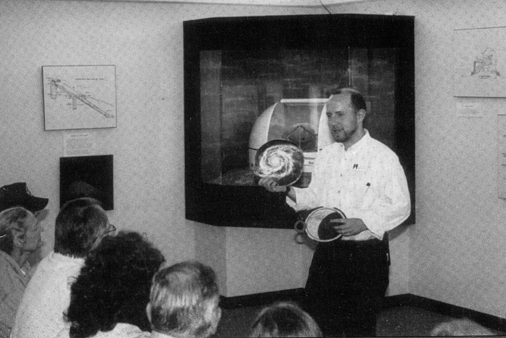
I like to sit guests down early in the evening and give my "How Big, How Far" talk, which illustrates the scale of the solar system and galaxy. This is a vital part of the program because it lays the foundation that the guests will call upon once they start looking through the telescope. It transforms a night of looking at a bunch of pretty, fuzzy blobs into a clear and comprehensible tour of the universe. It's easy to rattle off a bunch of big numbers here: 150 million kilometers, or 93 million miles, to the Sun, 2.4 million light-years to the Andromeda Galaxy. These numbers will astound the audience, but they will make almost no long-term impression. They're difficult enough to remember if written out, but if they are only spoken, remembering them is virtually impossible. People learn in a variety of ways, so the audience shouldn't be confined to simply using their ears. I like to give them something they can look at. This doesn't necessarily translate into lots of expensive visual aids. Instead, I like to make simple scale models that are virtually cost-free. For example, if Earth is the size of a typical globe, the Moon is the size of an orange about 10 meters (33 feet) away. That's easy to say, but only if people see it with their own eyes will they get the full, memorable impact. Hold the orange and have a guest hold the globe. If the solar system is reduced to the size of a penny, the 4.4 light-years to Alpha Centauri is 70 meters (230 feet) away. I like to use another penny for the hypothetical Alpha Centauri planetary system. "What system?" your guests may ask. No Alpha Centauri planets have been found, but a penny nicely encompasses any planets that might be there. The separation of Alpha Centauri A and B, on this scale, is equivalent to the distance from Abraham Lincoln's ear to his bow tie. If you have time, pace off the distance between the two pennies. Put the solar system penny down and start walking. After 70 meters, hold up the Alpha Centauri penny and say, "Here is Alpha Centauri. We've walked 4.4 light-years!" This brief stroll nicely demonstrates the vast distances between the stars and the emptiness of interstellar space (for more on the penny model, see www.noao.edu/outreach/nop/nophigh/steve2.html). If the Milky Way is the size of a dinner plate, the Andromeda Galaxy is another dinner plate about 7 meters (23 feet) away. Of course, have two dinner plates handy, and show your guests where the pinhead-sized globular clusters, the marble-sized Magellanic Clouds, and the compact disc-sized galaxy M33 are located. If you plan to look at irregular galaxy M82 later, then try something like, "On the scale of these plates, M82 would be a chili pepper over by the cash register." Have comments like these ready in addition to knowing factoids such as the Milky Way has about 200 billion stars and that 60 million light-years separate Earth from the Virgo Cluster. Familiar items such as pennies and chili peppers have a stronger impact and will be more memorable than flashy visual aids or mind-boggling numbers. 5) Mix it up and go for hands-on. We include constellation finding, a planisphere tutorial, and a primer in the use of binoculars before we go to the telescope. Because most of your guests won't own telescopes, observing with the unaided eye is a familiar and interesting way to start your presentation. You can start by pointing out constellations as the sky gets dark. People who have never looked up will be surprised at how Orion and Ursa Major jump out. Show them the Pleiades and the Coma Berenices star cluster. If there are two ormore planets to mark the ecliptic, and the Milky Way is visible, you can contrast the plane of the solar system to the plane of the galaxy. Scopeless guests can apply what they have learned the following night from their own backyards. If your sky is dark, there are probably half a dozen objects that can be found fairly easily with binoculars (consult Mercury's Sky Map for some interesting binocular objects). Giving the audience something they can hold in their hands and manipulate makes any program more real, personal, and memorable. Binoculars and planispheres are cheaper and easier to use than a telescope, so newly converted amateur astronomers really appreciate this sort of experience (refer to "Buying a Telescope," page 18).
6) Think multimedia. When we started our stargazing program, we discovered a problem with telescope viewing. It takes a long time for 20 people to look through a single eyepiece. We tried to have a few visual aids handy so while one guest was looking, we could entertain the other 19. Over time, our supply of multimedia devices expanded. Now, in the observatory dome we show CCD images, play videotapes of the Moon and planets, run computer simulations of orbital motions, refer to mounted posters of spectra, and doodle on an easel. It's okay to start with just one or two pictures. We certainly did. We acquired all of our CCD images and videotapes with the same telescope that the guests look through. 7) Don't worry about the advertising. We ask on our audience survey, "How did you hear about the Nightly Observing Program?" By far the most common response is "friends." Word-of-mouth, that all powerful force, does most of our advertising for us. Print simple flyers or brochures and make them available at your facility for visitors during the day. Call travel books or tourism guides that cover your state or city and have them update (or create) their entries about your program. Websites are cheap and they get the word out. Stargazing programs are still novel enough that a journalist may come by occasionally and write an article, providing free publicity. Don't spend a lot of money on self-promotion. You don't need to. 8) Communicate. Make sure that your daytime staff (who answer phones and take reservations) have experienced the observing program and can describe it accurately. Starting a nighttime program can greatly increase the daytime workload, so listen carefully to their concerns. Because Kitt Peak is above all else a research facility, we have to be absolutely certain that we do not interfere with the professional astronomers. When we initially pitched the idea for our program, some astronomers had horrible nightmares about the public wandering around the mountain after dark and causing all sorts of problems. It took some ace negotiating and some creative solutions, but we managed to work out a "zero-impact" arrangement. If you have active scientists at your facility, hear them out before you make any major decisions. 9) Cater to advanced amateurs. If you have the equipment for an evening stargazing presentation, you can manage an all-night program for motivated individuals. At Kitt Peak, we conduct the Advanced Observing Program two or three nights per week. The advanced program starts when the evening stargazing is over and lasts until morning. The cost is $250 and it is very popular.
We keep an operator around all night to run the telescope but we give the guest the freedom to observe any objects that he or she wants. At first, we invested in an off-axis guider, a reticle eyepiece, and a few T-adapters for astrophotography (and told guests to bring their own cameras). There are many amateur astronomers with the interest, but not the resources, to take their own astrophotos. Now, our guests do primarily CCD imagery, even with no previous astrophotography experience. 10) Start as soon as you can. At Kitt Peak, we are constantly purchasing, scrounging, or modifying our equipment. The activities and experiences we can offer in our program change continuously. We always have our eyes on the horizon and wonder what we can try next (translation: we are always salivating over a catalog featuring some high-tech gizmo we can't afford). If you are hesitant to start a stargazing program because you feel you don't have an ideal set of equipment, start anyway. A simple, poorly-equipped program is better than no program at all. The public will still appreciate it and will learn from it. That feeling of, "If I only had a so-and-so, the program would be so much better" probably won't go away, no matter what equipment you have. 11) Obtain donated equipment. There is absolutely no way the Nightly Observing Program could have gotten off the ground without the generous support of companies that gave us free stuff. We have received discounts and donations, including our telescope and the dome it is housed in, eyepieces, adapters, CCD cameras, and computer hardware and software. Most private businesses are receptive to helping out because in exchange for the discount or free equipment, they receive targeted and unique advertising. Fire off a round of polite letters to national manufacturers as well as to local astronomy retailers. Your guests are another possible source for contributions. A handful of participants in our program have donated a variety of useful technology, mostly high-tech computer systems or components. One guest even gave us an adaptive optics unit. A donation from a guest is a rare but wonderful surprise. You can't count on it but it can happen. Maximize your odds by producing the best stargazing program you can with whatever you have. 12) Be ready to overcome obstacles. We have our Kitt Peak nightlife pretty well established now, but it took a lot of work to get this far. If you decide to start a stargazing program, dig down deep for resolve and stick to it. Here are some problems that initially stumped us, followed by their eventual solutions. First, car headlights are not allowed on Kitt Peak at night. Solution: We tell guests to arrive before sunset. At the end of the evening we have the program guide lead them down the mountain on parking lights. We tape paper bags over daytime running headlights. Second, Kitt Peak is more than an hour's drive from Tucson, the nearest large city. With winter's early sunsets, guests must leave town in the mid-afternoon. What do they eat for dinner? Solution: We have the Kitt Peak kitchen staff prepare little boxed meals for them. We reimburse the kitchen accordingly. Third, it's too long a drive for people to come up and see nothing but clouds. Solution: We check a few weather satellite websites and listen to the local weather radio continuously all morning and afternoon, and make a call: scrub or go. If the show is canceled because of the weather, we call up all the guests, give the bad news, and have them reschedule. We're ready at the observatory to receive those we couldn't reach by phone. We give them a slide show and send them home at least partially satisfied. Naturally, all of our solutions are works in progress and require a lot of effort. Your facility may not have all of Kitt Peak's resources, but odds are you won't have all our obstacles either. Stargazing programs are an idea whose time has finally come. Daytime visiting hours for a planetarium, museum, or observatory are no longer enough. The people want more. So let's give it to them! Since writing this article, STEVEN W. WHITE (messier109@netzero.net) has left the Kitt Peak National Observatory Visitor Center for new adventures in Seattle, Washington. Copyright 2000, 2001 by Astronomical Society of the Pacific, all rights reserved. |
||||||||||||||||||||||||