|
General
Procedures for Filtration of a Precipitate
-
|
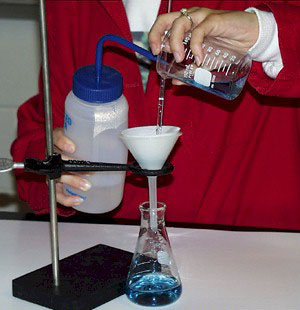
Figure
1: Technique for transferring a precipitate to a funnel
|
Allow the precipitate formed
to settle to the bottom of the container.
- Wet the filter paper
with a small amount of water or a liquid in which the precipitate is
insoluble.
- Decant (pour off)
the bulk of the solution into the funnel using a stirring rod. This
step, ensures the filtration will not be slowed by the precipitate clogging
the filter paper prematurely since most of the solution will have already
filtered through.
- Mix the precipitate with
the remaining solution and dump the resulting precipitate slurry into
the funnel. Simultaneously, spray a stream of solution from a wash bottle
to rinse out any slurry adhering to the walls of the container. (See
Figure 1.) Remember: the liquid or solution used for washing
the precipitate must be one in which the precipitate is insoluble.
- Wet a rubber policeman
with wash liquid and use it to help transfer any precipitate still
clinging to the container walls.
- Use a wash bottle to
rinse out whatever precipitate remains.
- Usually precipitates are
washed or rinsed to remove impurities, unless the filtrate
is the desired component.
- Typically 5 to 10 mL
portions of a wash solution are drawn through the funnel to wash the
precipitate.
- This may be repeated
several times to ensure that only pure precipitate remains.
- Allow air to be drawn
through the filter paper for several minutes to dry the precipitate
partially.
- Lift a corner of the
filter paper with a spatula or scoopula and then use the corner to pry
up the rest of the filter paper. Carefully transfer the filter paper
and precipitate to a previously weighed watch glass. Allow the precipitate
to air dry, or if it has a moderate melting point (above 70oC),
put the watch glass and precipitate in an oven to dry.

Source:
General Chemistry Lab, St. Mary's College of Maryland
Reprinted from:

|



 Society
for Amateur Scientists
Society
for Amateur Scientists  Sponsored by: