Society
for Amateur Scientists
Blowing Soap Bubbles in Sub-Zero Weather
Society
for Amateur Scientists
Blowing Soap Bubbles in Sub-Zero Weather| |
|
|
|
|
Society
for Amateur Scientists
Blowing Soap Bubbles in Sub-Zero Weather |
||
|
|||
|
|
|
Related Products: Society for Amateur Scientists
|
 Sponsored by:

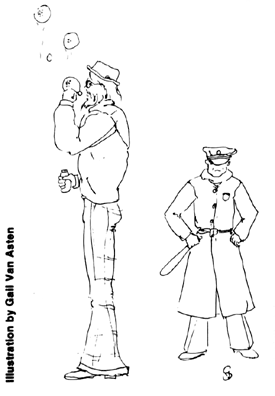
Blowing Soap Bubbles in Sub-Zero Weatherby Francis C. Van Asten Many interesting phenomena can be observed by the amateur scientist by altering just one condition of an everyday experience. the behavior of a soap bubble blown in sub-zero weather provides an example. Initially the bubble moves straight away from the blower as a result of the force of formation, then it turns milk-white because of the warmth and humidity of the human breath within it. the little warm-air balloon, then having lost its forward momentum and being lighter than the surrounding air, begins a rapid ascent. As it rises, the bubble will trail a long white "beard" behind it. This vapor trail can grow to be three or more feet in length if the air temperature is lower than thirty degrees Fahrenheit below zero.
When the soap bubble has lost most of its warmth by exhaling its water vapor behind it, the sphere will start to slow down. As it slows and comes to a stop, the globe will become perfectly transparent. The maximum altitude of the bubble seems to depend entirely upon the air temperature around it, not on the globe's size. in one experiment at minus thirty-five degrees, a consistent altitude of twenty-seven feet was obtained. After hanging in space between five and ten seconds at its maximum altitude, the sphere will begin losing height and begin wrinkling. As it wrinkles more and more, the bubble will become increasingly distorted. During its very slow descent it will crack and fracture many times. Many bubble skins rotate and glide as they drift earthward because of the strange shapes the remnant of the sphere assumes. Some skins glide much farther from the observer than the maximum height they attain above him. A close inspection of the remains of our adventurous little traveler reveals an incredibly wrinkled and torn piece of transparent material. When touched, it is found to be as gooey as enriched maple syrup. Left to itself, this crinkled little piece of soap slowly dissolves into a featureless mass. For best viewing, a single
street light thirty or more feet above ground level, on an otherwise dark
night, enhances the visibility of the effects. The effects of blowing
bubbles on cold winter nights become more pronounced as the temperature
goes further and further below zero. Any breeze at all will tend to confuse
the study. Although these special effects were first noticed by the author
in 1968, only a few nights since then have been ideal for studying these
phenomena. If only January would chill down to some really cold temperature,
say to minus sixty degrees Fahrenheit, effects too subtle to have been
seen as yet might then be observed. Originally published in Minnesota Technolog, Winter 1981.
|