This
column is intended for the amateur scientist who is familiar with basic
electronics concepts, but lacks an understanding of the (sometimes cryptic)
fundamentals of building and debugging electronic prototypes. You've
come across an experiment you'd like to try, but the project involves
building some electronics to control or monitor the experiment. You
have the scientific method down pat, but maybe your understanding is
a little fuzzy where anodes and cathodes are concerned.
Unless you are pursuing a
career in electrical engineering, most disciplines are exposed to little
beyond passive DC circuit analysis, if at all. Amateur scientists are
more likely to find themselves wandering down the self-taught path,
which can be very daunting. There are few texts that explain basic prototyping
techniques, and many circuit diagrams are laid out with the assumption
that the user understands certain conventions. I intend to convey some
of those techniques and describe those conventions.
One of the fundamental skills
necessary for electronic experimentation is breadboarding. The term
breadboard long predates my initial exposure to electronics, but my
understanding is that it refers to the wooden base upon which circuits
were laid out in the "early days" of electronics. These days,
breadboards are typically white plastic boards, generally referred to
as ‘solderless breadboards’, with a grid of holes into which
leaded components are inserted. There are strips of metal clips under
these holes, allowing for quick interconnection of relatively simple
circuits.
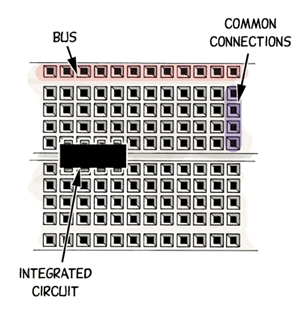
As most circuits involve
the use of ICs, the typical breadboard is laid out in such a way that
leaded integrated circuits fit nicely in the center of the board and
connections can be made between individual pins. Most typical breadboards
allow for four or five simultaneous connections on one column of holes.
Generally, there will be a row at the top and bottom of the board, electrically
isolated from the columns, allowing for bus connections. These busses
are usually used to supply power and a common ground to the circuit
(see figure 1).
figure
1.
Interconnections between
columns or busses are made either by the leads of the components themselves
(as in the case with resistors and LEDs, for example) or by lengths
of solid wire, generally 24 gauge. When assembling a circuit care must
be taken to ensure the connections are made between the proper holes
and that no bare leads are touching. I have let the smoke out of many
components because of bare leads shorting!
There are a few other issues
to be aware of when using breadboards. They are primarily used for circuits
that are low voltage, low current, and (relatively) low frequencies.
Keep this in mind when it comes to troubleshooting an intermittent or
non-functioning circuit. In addition, the metal clips in these boards
do wear out, especially if you use the same portion of board
repeatedly.
Interpreting circuit diagrams
is more straightforward, but there are still some ‘gotchas’
to look out for, the most common being related to the voltage supplies
to the circuit. Schematics are usually simplified by giving common points
names. It can be assumed that all points with the same name are electrically
connected. This is often the case with input/output lines associated
with various parts of digital circuit, but almost every diagram will
use this approach with power supplies.
Most diagrams will not include
the power supply itself, but will simply refer to the voltages necessary
to power the circuit. The main supply can be called out several different
ways, most often by the term ‘Vcc’ or by the nominal voltage,
for example ‘+5V’. There is sometimes a ‘B+’ line
providing higher voltages to certain parts of the circuit. Keep in mind
this would be a completely different bus from other supply busses. Historical
note: the term ‘B+’ dates back to early radio days when radios
had multiple batteries to supply different voltages throughout the circuitry.
Analog circuitry often has negative voltages to provide biasing for
various active devices. Negative supplies can be referred to as ‘Vee’
or again by the nominal voltage.
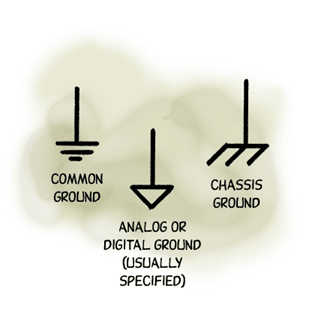
The same holds true for the
ground bus. This can be represented by various symbols (see figure 2)
or names on a schematic, but they all provide the same basic purpose:
provide the power supply current a return path to complete the circuit.
Depending on the circuit there can be different grounds in a circuit.
This occurs most often with so-called ‘mixed-signal’ circuitry
that combines analog and digital subcircuits in the same design. There
will often be grounding advice included with the schematic, but most
often analog ground and digital ground are treated as separate busses
and connected only at one physical point, generally close to the supply
(or as instructed on the schematic). Also worth noting is the chassis
ground, where the structure of the equipment upon which the circuit
is mounted is used as the return path.
figure
2.
Once you have your circuit
breadboarded, you can power it up, test it, and make changes as necessary.
When all is working properly, you rebuild the circuit on more permanent
etched copper boards, or use it as-is, depending on your needs. More
on constructing permanent prototypes at a later date..... 



 Society
for Amateur Scientists
Society
for Amateur Scientists  Sponsored by: