Society
for Amateur Scientists
Preserving Biological Specimens
Society
for Amateur Scientists
Preserving Biological Specimens| |
|
|
|
|
Society
for Amateur Scientists
Preserving Biological Specimens |
||
|
|||
|
|
|
Related Products: Society for Amateur Scientists
|
 Sponsored by:

|
Preserving Biological Specimens Adapted from A Practical Guide for the Amateur Naturalist by Gerald Durrell Before adding something to your collection you should always ask yourself whether it is going to be of value to you for future reference or whether you are just collecting for the sake of it. The Victorian period, when amateur naturalists took hundreds of specimens, is mercifully gone. Today it is essential to collect with a great sense of responsibility.
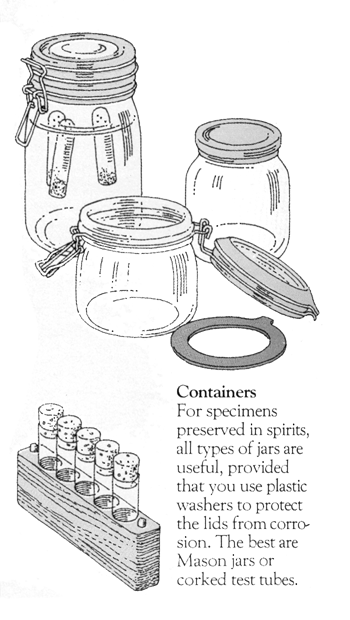
There are two ways of preserving specimens—the dry method, for example the pressing of flowers or taxidermy, and the wet method, which involves preserving in spirits. You have to choose the method of preservation which best suits the specimen so that its features remain intact and its color stays as natural as possible. Take great care with the preservation of your specimens—it is easy to destroy items needlessly. Wet preservation Preserve your specimens in either alcohol or formalin, both of which can be obtained from your druggist or a biological supplier. They preserve soft tissues well, but you still need strong glass or plastic containers with tight-fitting tops. An important advantage of this method of preservation is that there is no risk of your specimens being damaged by mold or pests, provided that you pickle them correctly. But wet preservation has the disadvantage that it does not allow internal examination of the specimen. For preservation in alcohol, you buy pure (or "absolute,") alcohol. To make the 70 percent solution required for preserving, dilute seven parts alcohol in three parts distilled water. Otherwise, you can buy ready-diluted rubbing alcohol. But if you do this, you must check the label to see if the dilution is correct. To produce formalin, you usually buy formaldehyde in a 40 percent solution. This needs further dilution—add one part 40 percent formaldehyde to three parts distilled water to make the ten percent formalin that is best for preserving. It is also possible to buy formaldehyde in crystal form and make a ten percent solution yourself.
Store your jars in a cool place to .prevent evaporation and minimize the risk of fire. Put a label on the outside of the jar, but because these tend to fall off, put another inside. Write all the details in Indian ink on thick paper, otherwise the preservative will make your writing vanish.
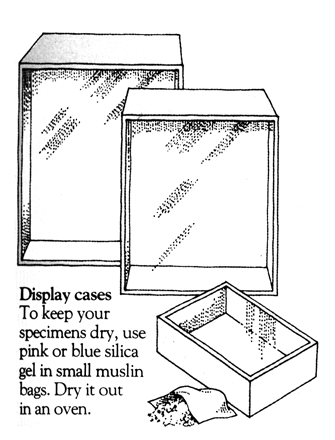
Dry preservation If you can preserve your specimens without alcohol, it is much cheaper and more satisfactory, but with dry specimens watch out for mold and insect pests. Try to keep specimens in a dry and dust-proof place. Cans are useful but they tend to ``sweat," so you should put muslin bags full of silica gel in them to absorb the moisture. Ideally you should have a proper specimen cabinet, but new ones are very expensive, though you can get secondhand ones more cheaply. But wherever you keep your specimens, protect them against pest damage. You can do this with either old-fashioned mothballs, flaked naphthalene or a blob of creosote in a cup. A piece of cotton that you dip in a concentrated solution of phenol, and allow to dry, will work in the same way. Both creosote and naphthalene need replacing as they evaporate slowly. If your dried plants become attacked by insects, dip them in a solution of pentachlorophenol and then re-dry them. All these chemicals are available both from pharmacies and from specialist biological equipment suppliers.
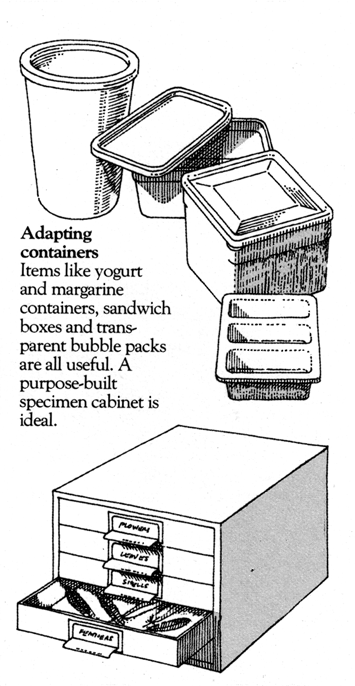
Everyday containers The resourceful naturalist can adapt containers that are thrown away in the average kitchen. Yogurt and margarine tubs are good for dry things such as birds' eggs or groups of beetles. Plastic containers with tightly sealed lids are good for larger specimens. A lot of jars and pots that once contained jam or honey are useful for "pickled" specimens. Clear glass ones are best, since you don't have to keep opening them to see what is inside. Long-term storage For long-term storage of a lot of specimens, you can use things such as cardboard or wooden boxes. An old chest of drawers or even an office filing cabinet is very useful if you make it light-proof and dust-proof with the aid of plastic draught excluders. Infestation
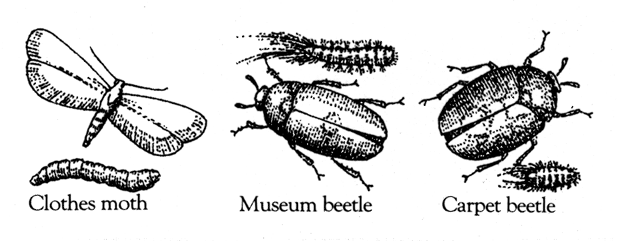
Check your collection every month to make sure that your dried specimens have not been attacked by insects or mold, and that there has been no loss of fluid by evaporation in specimens preserved in spirit. Mold on dried specimens shows as a furry or powdery covering. Soak the specimen in 10 percent formalin for 30 minutes, to kill the mold. But even after this treatment a regular check of specimens is vital. Never allow insect
pests to establish themselves in your collection. Holes in your specimens
and a fine dust or flaky bits underneath them provide signs of infestation.
It is best to destroy affected specimens, but if they are too valuable
fumigate them with ethylene dichloride or ethyl formate. Follow the instructions
carefully since these chemicals can be dangerous if not used correctly.
|