Astronomical
Society of the Pacific
What to Do in a Big Lecture Lecture Class
Astronomical
Society of the Pacific
What to Do in a Big Lecture Lecture Class | |
|
|
|
|
Astronomical
Society of the Pacific
What to Do in a Big Lecture Lecture Class |
||
|
|||
|
|
|
Related Products Astronomical Society of the Pacific
|
|
 What to Do in a Big Lecture Lecture Class,
Besides Lecture?
What to Do in a Big Lecture Lecture Class,
Besides Lecture?
sponsored by

|
What to Do in a Big Lecture Lecture Class, Besides Lecture? Sure, students may be able to pass an exam, but do they really get useful knowledge and skills from astronomy classes? Quite often no, but there are ways to challenge them, to teach them, and to show them the beauty of the science. by Douglas Duncan Reprinted from Mercury, Jan.-Feb. 1999. Educational studies have clearly shown that for significant and lasting learning to take place, students minds must be active. When students take a new concept and begin to relate it to what they already know about the world, try and apply it to solve a problem, or explain it to another person, they are engaging in the sorts of activities which have been shown to result in lasting understanding. Listening passively to a lecture–even a good, clear one–fails to achieve the same results. When taught by traditional means, students can often pass a test, yet be unable to apply the same concepts in the real world. Furthermore, much of any knowledge they have gained passes from their minds not long after the final exam. This article describes one way to encourage active student learning in a "breadth requirement" course for non-science majors. The method also has had a considerable positive influence on students' attitudes about science.
Is the Message
Being Received? In educational jargon, constructivist learning means that a student has learned a concept in such a way as to build it into his or her own world picture; the student must actively work for this to occur. Constructivist methodologies are built into the national science standards, which emphasize that science is something students must not just memorize, because active learning has been shown to be more lasting. Jargon aside, many readers (scientists and nonscientists as well) may recognize the truth of what I've described by thinking carefully about their own experiences. When Richard Feynman lectured my freshman physics class, his explanations were wonderfully clear and simple. Only when I went to do the homework problems did I realize that there was much more to the material than I first thought. And only after many hours of work did I actually begin to understand many of the concepts in a thorough way.
A related conclusion from this sort of research shows that when students have a wrong idea, learning a correct explanation often will not change their minds in a lasting way! Contrary to what is sometimes assumed, students don't enter a first science class with no ideas about the way the world works. At an early age our thoughts are influenced by watching cartoon characters run off cliffs, hearing explanations from others which may or may not be accurate, etc. Aristotle held concepts which are sensible but wrong. So do our students, and these concepts are surprisingly resistant to change. Research evidence shows us the way to deal with this resistance, however: We must allow the students a chance to apply their own ideas to problems, and only if these ideas fail are the students likely to replace their previous concepts with ones learned from us. Thus, we know the circumstances and techniques which best facilitate student learning. The methods typically take more time, and are most effectively done in small groups. They include hands-on activities, connections to the real "outside the classroom" world, and discussions of results. Those of us who teach at colleges and universities, however, almost always have large lecture classes to teach. Conditions in those classes are diametrically opposed to those which enhance true learning. What can one do, in a big lecture class, to enhance the active kind of learning which has been shown to be desirable? In other words, "What can one do in a big lecture class, besides lecture?"
Meeting
the Challenge This extensive class length gave me further incentive to try something besides a pure lecture. Before discussing my method, which I call the "Weekly Challenge," I need to outline the goals of the course. Success can only be measured when there is a standard to measure it against; my course goals are given in the box "Main Course Goals." A powerful start for improving science teaching is to actually write down and discuss your goals before beginning to teach. As obvious as this sounds, it is rarely done. When it comes to Astronomy 101, many astronomers "Just do it." I found that examining the actual class goals gave me the freedom–indeed, the imperative–to discard what wasn't supporting the goals and to try some new ideas. I discuss the goals with the teaching assistants and with the students the first day of class. Working jointly with science educator Amy Southon, I also have been anonymously surveying student attitudes at the beginning and end of the term. Typically, 15% of my students say that they like science at the start of the term. One of my goals is to affect student attitudes about science.
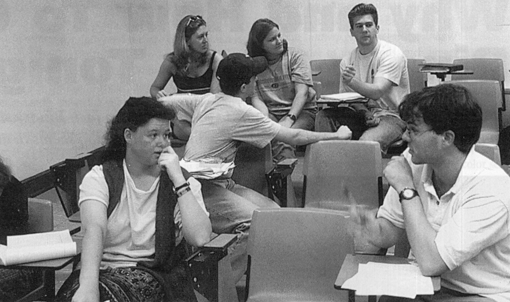
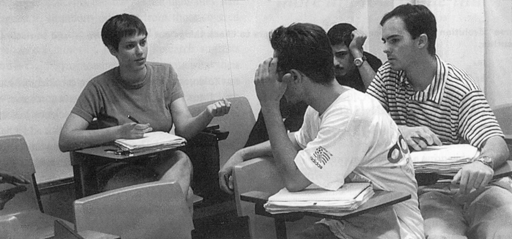
A goal worth discussing in more detail is that of getting students to understand what science actually is. What distinguishes science from other forms of learning is its emphasis on predicting and testing (experimenting) as a way of sorting out ideas which sound good, but are false, from ones which present a more accurate model of how the world actually works. This is not what most of the students think on entering the class. Our surveys reveal that a majority of students think of science as a body of knowledge–facts which they must learn. Furthermore, most students (as well as the rest of us, no doubt) think that most of their ideas are correct. They believe that if they write a good argument, they should get full or nearly full credit for their ideas. The idea that ideas must be constantly tested against external data is foreign to most of them. Suggestion that some of their basic ideas might be wrong is a surprise. Multiple goals could therefore be addressed by a "Weekly Challenge." This is an experiment which is set up in class every Tuesday twenty minutes before the end of lecture. Students are told to form into small teams of three to four throughout the lecture hall. At the beginning of class Thursday, the predictions are collected, and then the experiment is done.
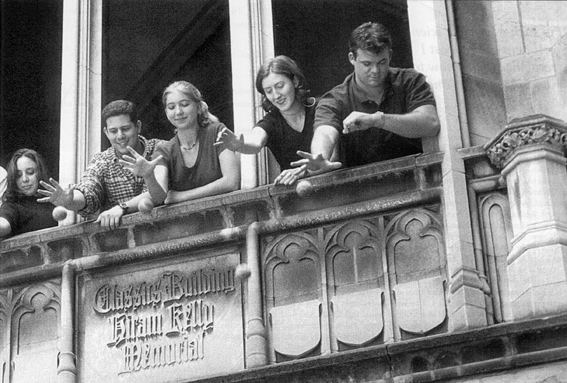
Of course we choose experiments whose results are not intuitive. This demonstrates the need to actually do experiments even when you think that you know the answer. Examples of the Challenges are given in the sidebar "Weekly Challenges." As soon as the challenge is given, the dynamic of the class changes dramatically. Students not only pay attention, they invest great amounts of energy in discussion with their peers. Not only is this a chance for them to get more information, it is very important to students how they behave in front of their peer group; I was unprepared for the strength of this response. Students quickly forgot all about me, and began to argue their ideas quite passionately with each other. It was not uncommon for groups to stay beyond the end of the period, lost in discussion and argument. On the week when the challenge was the Galilean one of dropping a heavy object and a light object (a bowling ball and steel marble in class), students were reported on Wednesday dropping various objects off dormitory balconies and timing their fall. Tennis balls stuffed with items to vary their mass were apparently the favorites. The keys to this high level of class involvement seem to be a good choice of "Challenges" based on simple, concrete experiments, and the division of the class into small groups. Naming the experiments "Challenges" was a fortunate accident. Students often took the name literally– as an enjoyable challenge to them. The interest generated by the challenges, and the fact that they were graded, likely contributed to the high class attendance this course enjoyed. Surveys taken at the end of the term revealed very positive student responses to the "Challenges." Changing Attitudes Many students remarked on the final survey that they discovered science could be interesting, and creative. Since most scientists I know particularly enjoy the interest and creativity science holds, it seems a great shame that students reach college thinking just the opposite! That this course approach altered the view of science of so many of the students convinces me that it is a good one which should be tried more widely. DOUGLAS DUNCAN is Associate Professor of Astronomy and Astrophysics at the University of Chicago. He is also the National Education Coordinator of the American Astronomical Society. Any materials mentioned in this article are available in their entirety from him. His email address is duncan@dei.uchicago.edu.
Copyright 1999, 2001 by Astronomical Society of the Pacific, all rights reserved. |