Society
for Amateur Scientists
Astrology
Society
for Amateur Scientists
Astrology | |
|
|
|
|
Society
for Amateur Scientists
Astrology |
||
|
|||
|
|
|
Related Products Society for Amateur Scientists
|
|
 Astrology
sponsored by

|
Astrology by Shawn Carlson First appeared in Experientia 44(1988) 279-90.
Introduction Although first conceived by the Babylonians circa 2000 B.C., astrology has been adopted and modified by many cultures. That astrology developed in relation to ancient cosmology is undeniable. Our distant ancestors populated the heavens with the divine beings. And since they believed the divine to be keenly interested and involved in human affairs, these peoples watched the skies with great interest and expectation. Certainly, they observed some correspondences between celestial events and life on Earth. Calendars which foretold the planting, harvesting, and hunting seasons were calibrated by celestial occurrences. These peoples also observed 28-day cycles in both the human female and the Moon. Eclipses and the appearance of comets, dramatic events in an otherwise changeless sky, terrified many cultures and were attributed to direct action by the Gods. From such observations, our ancestors inferred that celestial happenings foreshadowed the course of all human affairs. Specially appointed observers watched the night sky and, from the perspectives of their various religious traditions, interpreted how what they saw related to life on Earth. In medieval times, astrologers resided in nearly every king's court. Called upon to interpret history in terms of astrological influences and divine meaning from the appearance of comets, supernovae, and other dramatic astronomical events, court astrologers became politically powerful men. Their advice on foreign policy, health and medicine, and the military campaigns which forged both medieval Europe and the Far East shaped our history and forever changed the world. Even in the 20th century, astrologers have remained strong in number and powerful in influence, and their art has developed into many diverse forms: Natal astrology, Horary astrology, Sabian astrology, Humanistic astrology, Medical astrology, Astro-cartography, to name a few. To escape the stigma of ancient superstition, today's astrologers present themselves as modern professionals. The briefcase, three-piece suit, and computer are the modern answer for the dust-covered satchel, long robes, and astrolabe of old. But changing external trappings does not alter substance. The basic beliefs of today's astrologers were passed down from distant times without change. Astrology is still essentially medieval. Astrology has millions of followers worldwide. Every year, international astrological conferences, boasting attendance of hundreds to thousands, are held in the United States, the United Kingdom, Europe, Australia, and India. Europe has at least 18 major astrological associations; the U.S. has four associations with over 150 local chapters. Though disagreeing on the number of full-time astrologers there are in the United States, most U.S. associations' estimates range between one and ten thousand. Many of these individuals advance their craft by giving seminars and writing 'how to' books, of which more than 12,000 titles reside in the U.S. Library of Congress. Assuming that there are between one to ten thousand fulltime U.S. professionals, and that each of these ekes out a marginal living of $ 10,000 per year (many make significantly more), then astrology is a ten to one hundred million dollar per year industry in the U.S. For every full time astrologer there are probably ten part-timers and fifty serious students. Adding their revenues to the money made from thousands of books and tens of thousands of magazine sales, one thing becomes obvious: Astrology is big business. On realizing the size of the business and the degree to which astrologers affect their clients' lives, one may become justifiably concerned. Some people decide whether to get married on the advice of astrologers. Medical astrologers advise the clientele on what medical treatment they should or should not receive. 'Astro-cartographers' frequently counsel clients to move to other parts of their country and even to emigrate to where the astrological influences will supposedly be more favorable. Career choices, business ventures, how many children to have, in fact very important issues in many people's lives are decided on by astrological counseling. Clearly, if someone takes this kind of advice seriously, it can have a profound effect on one's well-being and that of one's family. And it is being taken seriously by many thousands in the West and millions in the Far East every year. A typical astrological counseling session, lasting about an hour, costs between $ 50-$200, and often even more. For their fee, astrologers claim to provide a very special type of counseling. Many astrologers hold themselves to be better than conventional counselors, for in addition to their counseling skills, they believe they possess 'arcane knowledge' that enables them to gain more information about their clients than could a skilled non-astrological counselor. The mystique of this occult knowledge instills in their clients the same reverence usually reserved for clergy. Thus, clients take their astrologers' advice very seriously.
Astrological theories
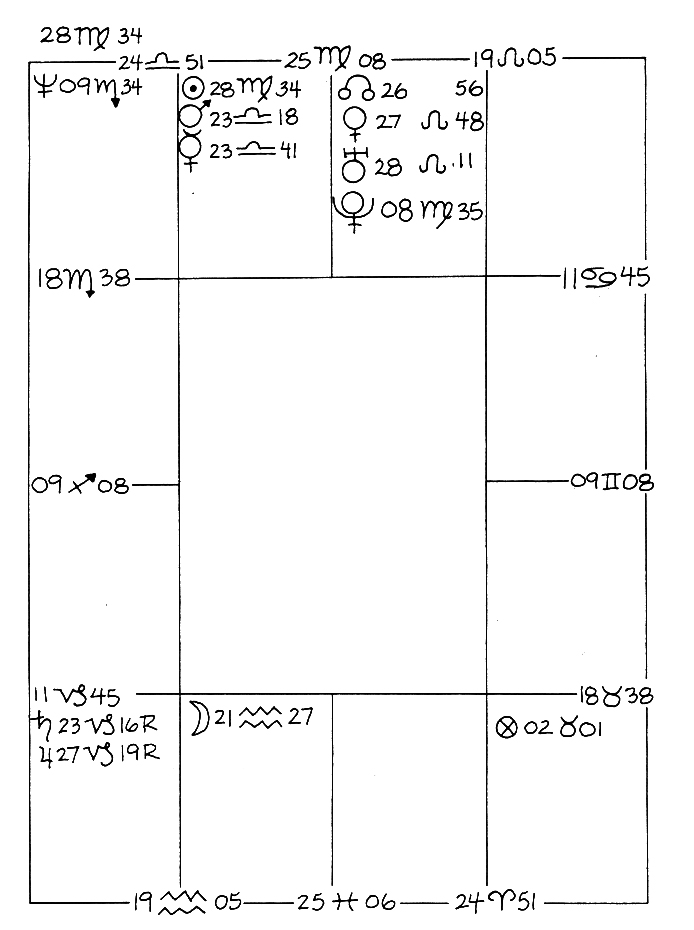
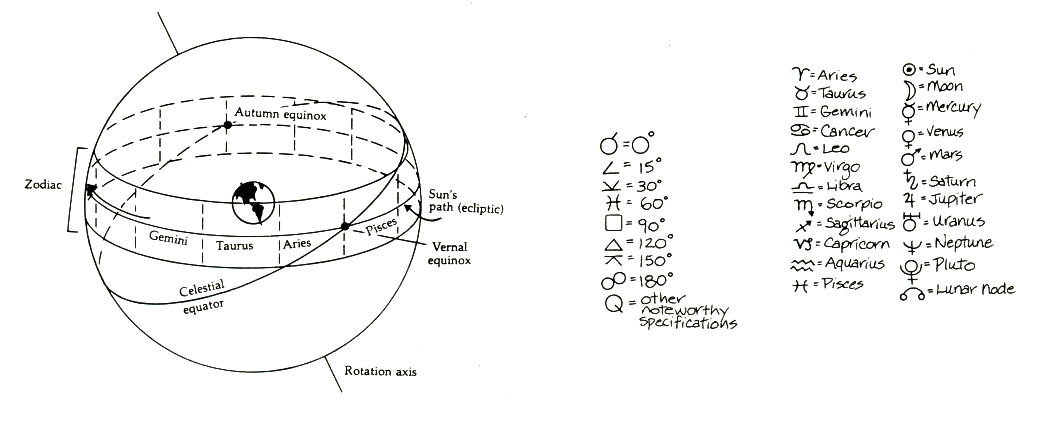
and beliefs Astrologers' deductions come from studying 'horoscopes', pictures that show the positions of the planets and constellations as seen from some place and time on Earth. An astrologer's counsel is largely based on a horoscope, called a 'natal chart', derived from the place and time of a person's birth. A sample natal chart is shown in figure 1a. The Earth moves in a plane, called the 'ecliptic plane', around the Sun. Although the stars reside at vastly different distances from us, they appear to sit on a large 'celestial sphere' centered about the Earth as shown in figure 2 (see below). The horoscope is derived by noting the apparent position of astrological objects with respect to both the celestial sphere and the Earth's horizon. The Sun appears to reside in one of twelve constellations that ring the ecliptic plane. As the Earth moves in its orbit, the Sun appears to move, at a rate of about one per month through these background constellations. Astrologers believe that the constellations in which the Sun resided at the time of your birth strongly influences your personality. Astrologers divide the Sun's path into twelve 30 degree sectors called the 'signs of the zodiac': Aries, Taurus, Gemini, Cancer, Leo, Virgo, Libra, Scorpio, Sagittarius, Capricorn, Aquarius, and Pisces. The signs are so named because, when Ptolemy first established the Western system of astrology in 140 A.D., they corresponded roughly to the twelve constellations that happened to reside in the Sun's annual path. The first sign, Aries, begins at the position of the Sun on the first day of spring. This 'vernal equinox' is located by considering the Earth at the center of the celestial sphere. As shown in figure 2, the axis of the Earth's rotation is tilted so the ecliptic plane does not cut the Earth straight through its equator. If we project the Earth's equator out to the celestial sphere it forms a ring called the 'celestial equator'. As the figure shows, the celestial equator crosses the ecliptic plane in two places, the autumnal and vernal equinoxes. The sign of Aries begins at the spring crossing. Defining the signs with respect to the vernal equinox has lead astrology into some difficulty. The Earth can be thought of as a large spinning top. If the Earth traveled alone in space, its axis would stay forever fixed in one direction. However, the constant tug from the Sun and Moon causes the Earth's axis to slowly drift, or 'precess'. As the axis shifts, so does the celestial equator. Thus, the position of the vernal equinox slowly moves with respect to the background stars. Although this precession is very slow, only 1/72 degrees per year, the vernal equinox has shifted over the centuries so much that the signs of the zodiac no longer correspond to the background constellations for which they were named. Most of the sign of Aries now overlaps the constellation of Pisces, for example. Thus, if the newspaper horoscopes tell you that your Sun sign is Aries, odds are that the Sun was really in the constellation of Pisces when you were born.
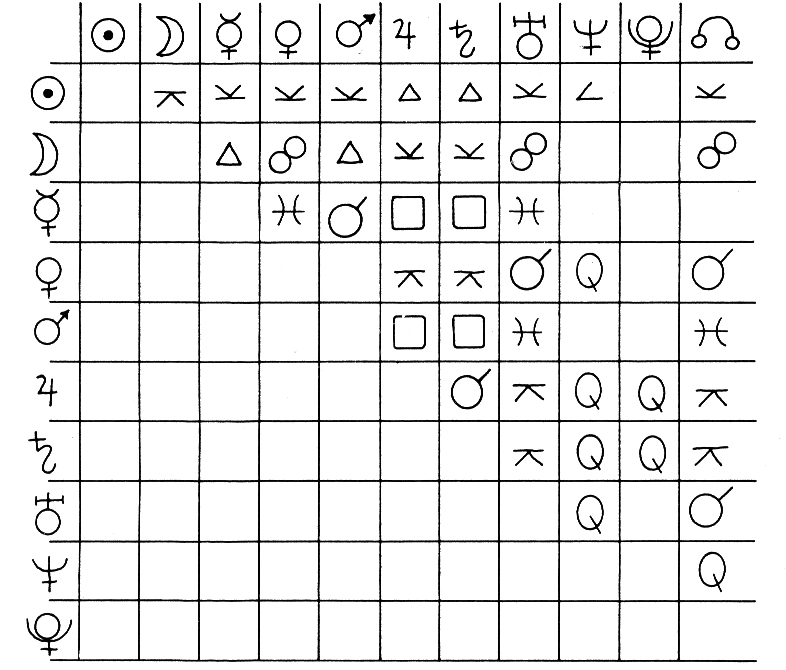
This presents modern astrologers with the problem of which zodiac they should use: the Sidereal zodiac which references the planets to the background stars, or the Tropical zodiac which references the planets to the vernal equinox. The choice is fundamental and there is no agreement. Two astrologers using different zodiacs will generally come up with contradictory conclusions about the same client. In fact neighboring signs carry many nearly opposite character associations. Thus, the precession has caused two nearly opposite meanings to be applied to the same sections of sky. Clearly, both systems cannot be correct. But this is only one of many fundamental disagreements between astrologers. To keep track of the planets' locations as the Earth rotates, astrologers divide the sky into 12 'houses' which rotate with the Earth. Astrologers believe that the effect a planet has on a person strongly depends on which house it resided in when that person was born. For instance, it is believed that Mars, if on the horizon when a person is born, affects that person differently than it would have had it been at its highest point in the sky. The rules astrologers use to divide up the sky constitute a 'house system'. There are at least three fundamentally different house systems being widely used today, all of which lead to different interpretations of a person's personality. Two of these, the Placidean and Koch systems, fail to define houses for the 12.5 million people born above a latitude of 66.5 degrees 5. Thus, although astrologers believe they can describe all people's characters, the house systems most preferred cannot be used to construct natal charts for all people. Astrologers do agree that the known planets, together with the Sun and Moon, should be included in a chart and they generally agree on what significance these should have. But many astrologers include some things which other astrologers disdain. The location of the center of the galaxy, the position of asteroids and comets, and the places where the planets cross the ecliptic plane are all used by different astrologers. Many even use 'esoteric (i.e. fictional) planets'. Though these 'planets' do not correspond to any physical body, they are imbued with orbits. Nearly one hundred such objects have been used, ranging from unseen satellites of the Earth, to planets with trans-Plutonian orbits. Esoteric planets work so well, some Hindu astrologers report, that accurate readings can be obtained even when three of the known planets are ignored 36. Horoscopes also include a table showing the angular relationships (or 'aspects') between the planets as shown in figure 1b. If two planets are separated by 0, 60, 90, 120, or 180 degrees (the 'major aspects') or by 30, 45, 135, 150 degrees (the 'minor aspects') their effects are altered in a variety of complicated ways. Not all astrologers use the same aspects. Since two planets are rarely exactly any particular angle apart, astrologers include the aspect if the planets are close to a given separation, there being no agreement about what 'close' means. Most astrologers select an 'orb' of between 2 to 5 degrees and include all aspects that fall within it. Obviously, the larger the orb, the more aspects there will be. Thus, the selection of the orb will affect what information an astrologer derives from a chart. Worst of all, there is no agreement as to how the whole chart should be interpreted. There is no agreement even on a basic philosophy of interpretation. Some astrologers believe that every factor in a chart has its own meaning and makes its own contribution that can be included by rigorously following a set of rules. Others teach that chart interpretation is a gestalt process and emphasize the importance of intuition in deciding what factors are dominant in a given chart. Still others use the chart in conjunction with 'psychic' impressions. Such interpretations range from mostly astrological interpretations with only a little bit of 'psychic' information, to mostly 'psychic' use of the chart for inspiration. As a field of knowledge, astrology is a quagmire of contradictions. The many different schools of interpretation use many different methods of chart construction and offer many mutually inconsistent conclusions about a given person's character. The different schools disagree violently on most of the fundamental issues involved in chart interpretation, each believing itself to be the school closest to the ultimate astrological truth. Since at most one school could be correct, the majority of astrologers must be fooling themselves and their clients. The
case for empirical investigation These tactics, and the fact that most people willing to spend their money on such counseling believe in astrology already, make it easy to see why astrologers are so successful. That people recognize general personality descriptions as accurate for themselves, and can be satisfied even when astrologers use a wrong chart to describe their personality, is well established. (6, 8, 14, 19) Astrological texts are replete with natal charts of famous people. Astrologers analyze these, knowing full well the character of the individual, and are able to justify their preconceptions about their own astrological systems. But do they recognize an inaccurate chart when they see one? When Geoffrey Dean showed a large group of astrologers what they believed to be British singer Petula Clark's natal chart, they derived descriptions that exactly matched her personality. Unfortunately, the chart was in fact that of mass murderer Charles Manson (13), Niehenke (34) found three publications analyzing John Lennon's natal chart, each postdicting the exact time of Lennon's violent death. However, each was derived from a different birth time. There are numerous similar examples (15). It seems that astrologers can interpret any given natal chart to mean exactly what they want it to.
Many astrologers doubt the value of scientifically investigating their craft. They claim that the language of astrology is symbolic or that astrology is somehow enmeshed with the human soul and as such defies experimental quantification. These astrologers attempt to place their craft on a pedestal so high as to make it unassailable by empirical inquiry. Their belief in astrology is unbreachable. Any empirical evidence discounting their claims is immediately dismissed as irrelevant. However, such a position is inconsistent with astrologers' justifications for believing in their abilities in the first place; that they have observed that the information they give to their clients is accurate. Astrologers admit that it is possible for clients to recognize general personality descriptions as accurate for themselves, and that 'cold reading' is possible. Their confidence in their abilities comes from their belief that they have observed that astrology yields much more accurate and detailed information about their clients than could be obtained through normal counseling techniques. They do not, however, concede that the lack of controls on their observations, nor their desire for self-justification could affect their conclusions. Nevertheless, they justify their services based on the same kind of observation that they repudiate when applied by skeptics. It is possible that science would be unable to discover the mechanisms responsible for astrology but the basic issue is scientifically resolvable. Either the astrologers can get accurate information from their clients' natal charts or they can't. In fact, considering the degree of detail they claim to reveal in order to justify their right to counsel, and to charge their often substantial fees, verification ought to be a simple matter. To date, researchers have taken three approaches to investigating astrological influences. Some have searched for irregularities in chemical reactions and biological processes that could only be attributed to astrological effects. Although interesting, the results (controversial at best) do not relate to astrologers' claims, and will not be described here. Other researchers have statistically tested astrologers' accepted correspondences between planetary configurations and people's lives. These studies do not involve astrologers personally. Lastly, some researchers have directly tested astrologers' ability to obtain accurate information from horoscopes. These are the most straightforward tests of astrologers' claims. The
statistical approach However, the Gauquelins do claim to have found several weak but statistically significant correlations showing that some planets appear in certain sectors of the sky at the time of birth more frequently for the 'eminent' professionals of some fields than for non-eminent professionals (22), The most famous of these correlations is the so-called 'Mars effect', a claimed 5 percent non-randomness in the position of Mars at the time of birth for sports champions. The results were replicated by the Belgium Comité Para using an independent sample of 535 Belgian sports champions (4). While they fell short of endorsing the Gauquelins' conclusions, the Comité Para agreed that the sector distribution for Mars was non-random for their athletes. However, a second independent test using 408 U.S. sports champions found no significant Mars effect (32). The Gauquelins have also reported that children tend to be born with the same planetary configurations as were their parents (27, 28). This 'planetary heredity', originally reported as extremely significant (p < 0.00001), has recently been challenged by Michel Gauquelin himself. Gauquelin discovered a bias in his interpolations of planetary positions from published tables that made the effect appear much stronger than it was (25) and reports that a recent replication, involving 50,000 subjects, has failed to produce any significant effect (24). Thus, it now appears that the planetary heredity effect was spurious. This recent failure is very serious, for the Gauquelins also reported that planetary heredity passed rigid self-consistency checks. First, it appeared in several independent data sets. Second, it vanished when births were induced by Caesarian section. Third, the planetary distributions shifted by the correct amounts when births were sped along by the use of forceps to pull the baby through the birth canal (18). (A doctor may induce a Caesarian birth at a time of his or her choosing, but the use of forceps requires the natural birth process to proceed to near completion.) The Gauquelins also claimed to have observed a correlation between the strength of the planetary heredity effect and the degree of activity of the Earth's magnetic field (26). If the planetary heredity effect was spurious, then the fact that it showed up in independent tests, always in just the ways that one would expect if planetary heredity were real would demonstrate a clear bias in the Gauquelins' experimental procedures. This would not bode well for the Gauquelins' other reported discoveries. Astrologers frequently quote the Gauquelins' research and claim that a weak correlation in some outstanding athletes somehow implies that they can perform their advertised services. Michel Gauquelin disagrees. "The horoscope is a product that is bought and sold, and that leads people to dreams. But the dreams of the clientele are answered by the deceptions of the charlatan, as well as by the illusions of the researcher who is sincere but not very lucid . . . Serious scientific examination is never favorable to this ancient doctrine. . . The horoscope is certainly a commercial reality, but it is a scientific illusion, or rather just an illusion." (23) Probably the most famous astrological claim is that the phases of the Moon affect human behavior. Studies linking the phases of the Moon to crime rates homicide rates, suicide rates, automobile accident rates and so forth, have been published. Several extensive reviews of this evidence have now been done and show that there is no strong evidence to support these claims (31, 37). Numerous studies searching for correlations between Sun sign and human behavior have been published. All of them either show no effect or are flawed in design (16). Four such tests are frequently quoted and are summarized below. In 1978, a respected psychological journal published a study co-authored by an eminent British psychologist, Hans Eysenck, and British astrologer Jeff Mayo, that claimed to observe a weak correlation between personality traits as measured by the Eysenck Personality Inventory and Sun signs (33). While one subsequent study confirmed the effect (29) a second replication failed (40). However, the fact these authors failed to take into account was that the subjects could bias the results if they were aware of the personality characteristics attributed to their Sun sign. When this 'self-attribution' possibility was controlled for, the effect vanished (35). Eysenck later retracted his claim (20). The experiment has been repeated twice more, both times with results consistent with pure chance (30, 38). The prestigious British newspaper, The Guardian, published the results of a massive search for correlations between Sun signs and occupations conducted by Alan Smithers, head of the Department of Education at Manchester University. Smithers' study used the records of the 1971 British Census to obtain a sample of over 1,469,000 men and 842,000 women each assigned to one of 223 occupations. A total of 16 recognized expert astrologers made predictions of correlations that would be found between Sun signs and occupations. Smithers stated he 'remained unconvinced' but suggested that some of the astrologer's predictions were confirmed. However, a later critique of the study clearly showed the results were attributable to statistical fluctuations, and people making decisions based on knowing the characteristics associated with their Sun signs (12). Thus, even with nearly two and a half million people in the sample, correlations that astrologers claim to observe on a daily basis could not be found. Astrologers' claims about the compatibility of couples have been tested several times. Professor Bernard Silverman, a Michigan State psychologist, compared the Sun signs of 2978 married couples with 478 couples who were divorced and discovered that those born under 'incompatible' signs were no more likely to be divorced than those born under 'compatible' signs, and those born under 'compatible' signs were no more likely to stay married (39). Other studies give similar results (17). James Barth and James Bennett of George Washington University looked at the horoscopes of men who re-enlisted in the U.S. Marine Corps. They assumed that those who re-enlisted in the Marines were more likely to have a 'war-like' personality than people who either never entered the service or were drafted. Mars is associated with aggressive and warlike behavior, while Venus is associated with gentleness and passivity. Since the signs of Aries and Scorpio are supposedly 'ruled' by Mars, traditional astrology holds that people born under these signs tend to be aggressive and warlike, while those born under Libra tend to be mild and compassionate. Barth and Bennett found that their Marines were no more likely to be Aries or Scorpios than Libras (1). Astrologers rebut such studies by pointing out that they focus on only one element of the natal chart. Astrologers rely on much more information to make an assessment of one's aggression or whether one is well-suited to one's partner. Astrologers usually claim that chart interpretation is a gestalt process, and that only an experienced professional can do it. Even if this were so, given enough statistics, individual factors have to crop up above chance at some level. When an experiment using samples containing in excess of two million people, as in the Smithers study, cannot find the predicted correlations there seems to be little hope for the astrological gestalt. However, the astrologers' objections may be avoided by testing the astrologers' abilities directly. Several such studies have now been done. Double-blind
experiments Clark's third test was 'double blind'; neither the astrologers nor Clark knew the answers to any experimental questions. Thirty astrologers participated. Clark obtained the natal charts of people possessing IQ's above 140, and people suffering from cerebral palsy, an incurable form of brain damage. Clark's purpose was to get two groups that represented extremes in learning ability. Clark matched the charts into ten pairs. Each astrologer reviewed the same set of pairs and tried to tell the palsy victim from the person of high IQ. If astrology did not work, one would naively expect the astrologers to guess correctly on five of the ten charts on average. In fact, the astrologers as a group averaged almost six out of ten correct. Unfortunately, Clark's experiment was poorly designed. Suppose the first astrologer's rules about how to find the palsy victim's chart happen to get him/her six out of ten correct. If all the astrologers tend to agree on what a palsy victim's chart looks like they will all tend to select the same charts; they will all average 60 percent correct. By having thirty astrologers look at the same pairs, any statistical fluctuation in the data is artificially magnified thirty times. If the average had been weighted so chance expectation was 60 percent, one can show that about one in 28 astrologers should have gotten a perfect score, as one of Clark's thirty astrologers did. Thus, Clark's results are consistent with chance expectations of a poorly designed experiment. In 1985, I published the results of a carefully controlled experiment (2). Its purpose was to give outstanding astrologers the best possible chance to apply their craft in a controlled setting to see if they could get accurate information about people they had never met. Three recognized expert astrologers consented to act as advisors on the experiment's design. They also selected those of their peers they considered sufficiently competent to participate, made 'worst case' predictions for how well their colleagues would do, and approved the design as a 'fair test' of astrology. Twenty-eight of the ninety astrologers who had been recommended by the advisors agreed to participate. Volunteer test subjects took a widely used and generally accepted personality test, the California Personality Inventory (CPI), to provide an objective measure of their character traits. The astrologers chose the CPI as the personality test, which came closest to describing those character attributes accessible to astrology. A computer constructed a natal chart for each subject. The experiment consisted of two parts. In the first, the natal charts were divided up amongst the astrologers. For each natal chart, the astrologers wrote personality descriptions covering material that they felt sure the subjects would be able to recognize as accurate. The subjects received their own astrologically-derived personality description and two others chosen at random, and were asked to select the description that they felt best fit them. Extensive controls were established to eliminate self-attribution and other possible biases. If astrology does not work, one would expect only one third of the subjects to select the correct personality descriptions. The astrologers' own 'worst case' prediction was that the subjects would score at least 50 percent correct. In the second test, the natal charts were again divided up amongst the astrologers. For each natal chart, the astrologers were given three CPI test results, one of which correctly corresponded to the given natal chart. They were asked to make a first and second place choice as to which CPI came closest to matching each natal chart, and rate how well each fit the natal chart on a one to ten scale. If the natal chart contains no information about the subject, the astrologers had a one in three chance of making a given selection correctly. Their worst case prediction here, too, was a score of at least 50 percent correct. The subjects failed to select the correct personality descriptions more than one third of the time. However, if people tend not to know themselves very well they would be unable to select the correct descriptions no matter how well astrology worked. Since the CPI descriptions are known to be accurate, each subject was also asked to select his or her own CPI from a group of three. Since the subjects were also unable do this, their failure to select the correct astrological description could not be held against astrology. However, astrologers' confidence in their abilities comes from their clients' ability to recognize astrologically-derived personality descriptions as accurate. The subjects' failure here means either astrology does not work, or people do not know themselves well enough to recognize the astrologers' descriptions as accurate when reviewed in a controlled setting in which two alternative descriptions are also presented. Either way, these results show that astrologers' faith in their abilities is unfounded. The astrologers failed to match the correct CPI's to the natal charts. They scored exactly chance and were very far (3.3 standard deviations) from their 'worst case' prediction of 50 percent correct. Even worse, the astrologers did no better when they rated a CPI as being a perfect fit to a natal chart. None of the astrologers scored well enough to warrant being retested. Thus, even though the astrologers started off very confident that they would pass this test, they failed. Geoffrey Dean has conducted a similar series of experiments. After testing over one thousand people, he used the natal charts of those who scored as being either extremely emotional/stable, or extremely extroverted/introverted by the Eysenck Personality Inventory (EPI), where 'extreme' means the two most extreme scores out of fifteen. "If astrology cannot correctly judge the two most extreme persons in every 15," Dean reasons, "there is clearly no hope for the other 13" (9). These character traits, most astrologers feel, are strongly indicated in a chart. Dean's first experiment tested whether computer analysis of various astrological factors could be used, either individually or in combination, to discern extroversion and emotionality in his extreme subjects (9). No factors scored above chance. To counter the objection that only experienced astrologers, and not computers, can interpret a chart, Dean conducted a second test that allowed 45 astrologers to try to discern the extreme personality traits by scrutinizing the natal charts (10). He discovered that the astrologers could make the selections when they could get clues from his body language. However, when these clues were eliminated, the astrologers scored no better than chance. Says Dean, "In light of the negligible effect of intuition in the main test, this suggests that the supposed efficacy of intuition in everyday practice owes a great deal to cold reading, and not much to anything else. The astrologer concerned with maximizing accuracy, and therefore client satisfaction, could therefore do worse than to abandon astrology (but not the pretense of astrology) in favor of cold reading'' (11). Dean also found that the astrologers did not even agree on how to interpret the charts to find these extreme factors. Conclusions If an astrologer is a skilled counselor and a caring person, he/she may be of benefit to his/her clientele. However, most astrologers have no training in counseling. Many studied astrology because its unconventionality appealed to their own unconventional natures. A few are outright charlatans who use astrology as a scam to bilk the gullible. A person with a real problem, is, in my opinion, courting disaster in seeking astrological counseling. One would be much safer in the hands of a trained, licensed, respected and reputable counselor. Society requires safeguards to protect the public against charlatanism, fraud, and quackery. Our standards rightly require one to demonstrate, before impartial observers, that one can perform the service for which one charges. Considering the effect they have on peoples' lives, it is clear that astrologers should be held to the same standards as auto mechanics, plumbers, hair dressers, and other accredited professionals. This means two things. First, astrologers should be certified as counselors before they be permitted to perform their counseling service. Second, they should stop advertising abilities they can not demonstrate. Astrologers may reasonably claim that they have a language for the psyche that some people find insightful, but they must stop claiming that they can get accurate information about a person from a natal chart unless they can prove it in a double-blind examination. Certainly,
astrologers should support testing by an impartial accrediting body to
weed out all practitioners who cannot perform successfully. In addition
to resolving the age-old schisms between various astrological schools,
this would go a long way towards protecting the public against fraud and
incompetence. Until this is done, astrology must be perceived as a threat
to the public health and, as such, struggled against.
References: I Bennett, J., and Barth, J., Astronomics: A new approach to economics? J. Polit. Econ. 81(1973)1473-1475. 2 Carlson, S., A double blind test of astrology. Nature 318 (1985) 419-425. 3 Clark, V., Experimental astrology. Aquarian Agent 1 (1961) 22-23. 4 Comité Para, Nouvelles Breves 43 (1976) 327-343. 5 Culver, R., and lanna, P., The Gemini Syndrome: A Scientific Evaluation of Astrology, pp. 59-61. Prometheus Books, Buffalo, N.Y. 1984. 6 Culver and lanna 5, capt. 7. 7 Culver and lanna 5, pp. 143-147. 8 Dean, G. A., The acceptance of astrological chart interpretations: A simple test of personality validation using reversed charts, Paper presented at the 2nd Astrol. Res. Conf. Inst. of Psychiatry, London. November 1981. 9 Dean, G. A., Can astrology predict e(xtraversion) and n(eutroticism)? Part 1. Individual factors. Correlation 5 (1986) 4. 10 Dean, G. A. Can astrology predict e(xtraversion) and n(euroticism)? Part 2. The whole Chart. Correlation 5 (1986) 2. 11 Dean, G. A., Prepublication copy. 12 Dean, G. A., Kelly, I. W., Rotton, J., and Saklofske, D. H., The guardian astrology study: A critique and reanalysis. The Skeptical Inquirer 9 (1985) 327-338. 13 Dean, G. A., Planets and personality extremes. Correlation, vol. 1, pp. 15-18. 14 Dean, G. A., Recent advances in natal astrology. Analogic (1977) 28-31. 15 Dean, 14,p.29. 16 Dean, 14,pp.84-131. 17 Dean, 14, pp. 131-134. 18 Dean, M., The Astrology Game, pp. 247-251. BeauDord Books, New York 1980. 19 Dickson, D. H., and Kelly, I. W, The Barnum Effect in personality assessment. Psychol. Rep. 57 (1985) 367-382. 20 Eysenck, H., Astrology: science or superstition? Encounter (1979) 85. 21 Gauquelin, M., The Cosmic Clocks, p. 84. Henery Regnery Company, Chicago 1967. 22 Gauquelin, M., Cosmic Influences on Human Behavior. Garnstone Press, London 1974. 23 Gauquelin, M., Dreams and Illusions of Astrology, p. 157. Prometheus Books, Buffalo, N.Y. 1979. 24 Gauquelin, M., Reappraisal of Planetary Heredity in 50,000 Family Data, New Birthdata Series, vol. 2. Laboratoire d'etude des relations entre rythmes cosmiques et psychophysiologiques, Paris 1984. 25 Gauquelin, M., Profession and heredity experiments: Computer re-analysis and new investigation on the same material. Correlation 4 (1984) 8-24. 26 Gauquelin, M., and Gauqudin, F., Replication of the Planetary Effect in Heredity. Laboratoire d'etude des relations entre rythmes cosmiques et psychophysiologiques, Paris 1977. 27 Gauquelin, M., and Gauquelin, F., Series B (Hereditary Experiment), vols. 1-6. Laboratoire d'etude des relations entre rythmes cosmiques et psychophysiologiques, Paris 1970. 28 Ganquelin, M., and Gacquelin, F., Series C, vol. 1, pan 2. Laboratoire d'etude des relations entre rythmes cosmiques et psychophysiologiques, Paris 1972. 29 Jackson, M., Extraversion, neuroticism, and date of birth: A Southern Hemisphere A Study. J. Psychol. 101(1979)197-198. 30 Jackson, M., and Fiebert, M., Introversion-extroversion and Astrology. J. Psychol. 105 (1980)155-156. 31 Kelly, I. W., Rotton, J., and Culver, R., The Moon was full and nothing happened: a review of studies on the Moon and human behavior and lunar beliefs. The Skeptical Inquirer 10 (Winter 198586). 32 Kurtz, P., Zelen, M., and Abell, G., Four-part report on the claimed 'Mars effect'. The Skeptical Inquirer 4 (Winter 1979-80)19-63. 33 Mayo J., White, O., and Eysenck, H., An empirical study of the relation between astrological factors and personality. J. soc. Psychol. 105 (1978) 229-236. 34 Niehenke, P., The whole is more than the sum of its parts. Astro-Psychol. Prob. vol. 1, pp. 33-37. 35 Pawlik, K., and Buse, L., Self-attribution as a differential psychological moderating variable. Z. Sozialpsychol. 10 (1979) 54-55. 36 Raman, B., Hindu Predictive Astrology, p. 12. The India Book House, 1972. 37 Rotton, J., and Kelly, I. W., Much ado about the full Moon: A.meta-analysis of lunar-lunacy research. Psychol. Bull. 97 (1985) 286-306 38 Saklofske, D., Kelly, I., and McKerracher, D., An empirical study of personality and astrological factors. J. Psychol. 110 (1982) 275-280. 39 Silverrnan, B. I., Studies of astrology. J. Psychol. 77 (1971) 141-149. 40 Veno, A., and Pamment, P., Astrological factors and personality: A southern hemisphere replication. J. Psychol. 101(1979) 73-77. |