Society
for Amateur Scientists
Collection and Preservation of Algae
Society
for Amateur Scientists
Collection and Preservation of Algae| |
|
|
|
|
Society
for Amateur Scientists
Collection and Preservation of Algae |
||
|
|||
|
|
|
Related Products: Society for Amateur Scientists
|
 Sponsored by:

|
Collection and Preservation of Algae Source: Smithsonian Institution, National Museum of Natural History
Preservation
of Marine Algae
PRESERVATION OF
MARINE ALGAE
|
|
|
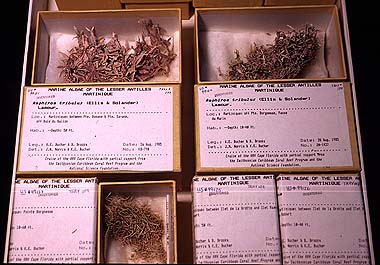
After first fixing the specimens in 3-5 % Formalin, select portions to be liquid preserved in a vial. Soak for several days in a solution of about 40% glycerin in 3% buffered Formalin seawater. Dry and place in small boxes without pressing or, where appropriate, glue carefully to herbarium paper. |
Additional information may
be found at: An Introduction to Nongeniculate Coralline
Algae. This server is maintained by Derek Keats at the University
of the Western Cape, South Africa.
NOTE: Some researchers prefer that glycerin not be used, as it may harm the reproductive structures inside the conceptacles.
|
|
Prior to pressing the specimen, a number or note should be written on the lower right hand corner of the herbarium sheet. This will aid in identifying specimens and allow for affixing the proper herbarium label after pressing. Also keep in mind the layout of the herbarium sheet when placing specimens on the sheet with regard to the label location (lower right corner) and herbarium stamp (usually upper right corner). The U.S. National Herbarium uses unbuffered long-fiber 100% rag mounting paper. (11 1/2" x 16 1/2" - 70M; White-Caliper.015) |
The larger coarser forms may
be placed directly on herbarium paper. However, delicate forms must be
placed on the paper while it is submerged in a tray or pan of adequate
size containing water (it may be tap water if specimens have been fixed),
which will allow for spreading the specimen.
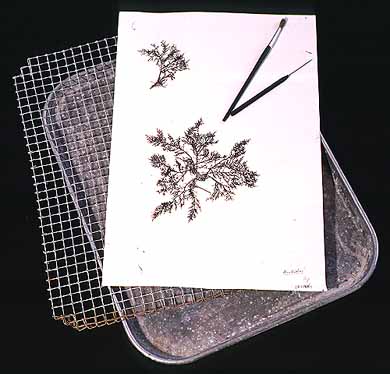
Place specimen (in water)
over paper, and using forceps, a pointed instrument, or a small, soft
paint brush for more delicate forms, pull out and separate branches, and
spread the specimen to reveal branching patterns and small structures.
If necessary, trim away (and note that this was done) an appropriate amount
of the specimen where excess material obscures structures.
Remove the paper very carefully
from the tray, at an angle so that water flows will tend to spread the
branches as the paper is being lifted. A squirt bottle of water may be
used at this point to further spread branches. Place the paper containing
the specimen(s) on a blotter. Then place a piece of muslin, cheesecloth,
a cloth "diaper" or crumpled waxed paper over the specimen, and add another
blotter on top.
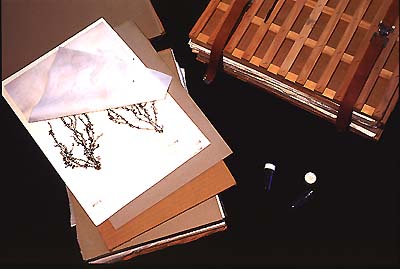
Place the blotter and specimen
sandwich between standard plant press ventilators (corrugated cardboard
or aluminum).
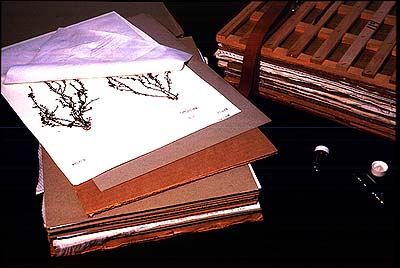
Continue adding specimens to
the plant press so that each specimen is covered with non-sticking material
and between a layer of blotters, enclosed by a layer of ventilators. Finally,
firmly tighten the straps of the plant press.
Moderately warm artificial
heat should be applied from below the press as it is placed on its side
so that warm dry air passes upward through the corrugations of the ventilators.
Alternately, the plant press may be placed in a fume hood so that the
sash closes on the press, allowing air to be drawn through the corrugations.
Heaters may be devised which include a rack to hold the press and a heating
source, such as light bulbs, a heating coil or a hot plate. Note that
warm air is all that is required. Too much heat will cause the algae to
darken and become brittle. Check specimens at least every 24 hours removing
any that are dry; wet blotters and "diapers" should be changed and the
straps of the plant press retigntened. If a heat source is not available,
blotters and diapers must be removed daily and replaced with dry ones.
Drying may require many days by this method, so a heat source should be
used if at all possible.
Remove press from heat source
and allow to cool with the straps tightened before opening. Specimens
may curl if exposed to a humid atmosphere before cooling, in which case
they must be wetted and re-dried.
Many specimens will remain attached to the herbarium sheet following drying due to the presence in the algal walls and intercellular spaces of colloidal "glues". The coarser, non-gelatinous forms (e.g. some Phaeophyta) may not remain attached after drying and may require "glue".
Any good clear-drying glue may be adequate, such as white glue or a white PVA resin. However due to problems with white glue becoming soft / sticky again (under humid conditions), the U.S. National Herbarium prefers to use "tin" paste (see below) applied in spots, to the underside of the specimen. Gummed linen herbarium tapes may also be used to "strap" the specimen(s) to the sheet.
"Tin" Paste Formula Mixing should be performed in a laboratory fume hood, wearing the appropriate safety equipment (lab coat, gloves, eye/face protection etc.).
Add the toluene and methanol in a large glass jug and shake to mix.
Add a small amount of this toluene/methanol mixture to a beaker containing the weighed resin and stir well to dissolve all of the resin.
Pour this mixture into the jug containing the rest of the toluene / methanol mixture and shake to mix.
Add the Ethocel and shake or roll the jug to mix well.
Wait 24 hours before using paste, and if needed, add a little more toluene to thin.
The paste should be dispensed in a well-ventilated environment,with the aid of an oil squirt gun available from automotive shops.
Reference:
Rollins, Reed C. 1955. The Archer method for mounting herbarium specimens. Rhodora 57: 294-299.
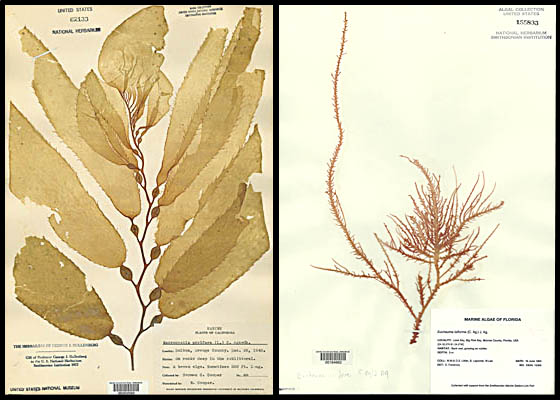
Using good quality (100% rag acid-free) herbarium label paper, complete the label and affix by means of a clear-drying cement (tin paste), to the lower right-hand corner of the sheet. AVOID gummed labels on poor quality paper.
The completed herbarium sheet should include a label, and may also have museum and barcode numbers, as well as annotation notes written directly on the sheet or on spereate labels.
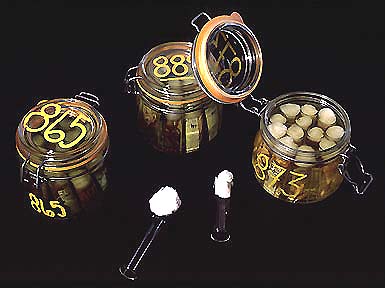
Any specimens that fit into a jar or vial may be "pickled" by using any of several different preservatives. Do not pack the specimens into the jar. The U.S. National Herbarium attempts to keep Formalin fixed, EtOH preserved (see below) portions of most specimens, with the exception of Corallines, which are kept in 3-5% Formalin. Most specimens are kept either in 4-dram (21 x 70 ml) shell vials inside canning jars, or in 20-ml scintillation vials with urea/ poly-seal cone caps, filled with the preservative.
Formalin - sea water / buffered.
3-5%. A good all-around fixing
solution and preservative.
Commercial 37% formaldehyde
(= 100% Formalin) is diluted with seawater to make a 3-5% Formalin solution
to which baking soda (sodium bicarbonate) is added as a buffer (to prevent
unfavorable increases in acidity) using approximately 40 gms. per liter.
Note: Too much buffer may be
detrimental. It has been reported that thalli may become brittle and disintegtrate
with the excessive addition of buffer.
Fix for 24 - 48 hours for thick,
cartilaginous algae. NOTE: If the specimen is to be stored for very long,
it should be kept in the dark, in sealed containers or bags, to prevent
bleaching.
Transeau Solution
6:3:1. Recommended by many
freshwater phycologists.
Contains 6 parts water, 3 parts
ethyl alcohol (95%), 1 part Formalin (commercial). If you figure the approximate
proportions, the water may be supplied in the sample and the added preservative
need only contain 3 parts alcohol to 1 part Formalin. It is convenient
to add the preservative using a squirt bottle.
Alcohol
70% EtOH. A good all-around
preservative.
Some herbaria require EtOH,
however isopropyl alcohol may be used.
At the U.S. National Herbarium,
the staff first fixes the specimens in 3-5 % Formalin for at least 24
hours before rinsing with tap water and transferring to 70% EtOH for permanent
storage.
F.A.A. (Formalin-acetic acid - alcohol).
A good all-around preservative
of particular value for preserving cell structures such as flagella.
DO NOT use F.A.A. on calcified
algae, such as Acetabularia. The acid will harm the specimen.
Formula: EtOH (50%), 100 ml + commercial Formalin, 6.5 ml + glacial acetic
acid, 2.5 ml.
Many of the chemicals used
in the preservation and staining processes may be listed as environmentally
hazardous. Therefore you need to be aware of possible hazards by consulting
the chemical's MSDS* label, and work accordingly. It is suggested that
all work with chemical solutions be conducted in a FUME HOOD and that
lab personnel wear appropriate eye protection, gloves and a chemical apron.
For example, you should be aware that formaldehyde has been classified as a possible carcinogen, and has a CERCLA rating of:
Health=2
Fire=2
Reactivity=0
Persistence=0
* MSDS - Material Safety Data
Sheet
Data sheet provided by the
manufacturer of the chemical which lists the environmental, health and
physical information concerning the use and disposal of the chemical,
as well as the suggested minimum personal protective equipment to be used.
This chemical information sheet typically rates the chemicals (CERCLA
- NFPA) by assigning a number for the chemical's respective health hazard,
flammability, reactivity and persistence. It is advised that you familiarize
yourself with this rating system.
Standard containers cannot prevent evaporation of preservatives. In time, all samples will go dry unless precautions are taken to refill them or to seal them. Some hints follow:
Addition of glycerin. A few
drops of glycerin added to a filled vial greatly aids in salvaging if
the contents go "dry". (The glycerin helps to maintain a bit of moisture
in what appears to be an otherwise dry vial). However, some siphons and
filaments will shrink when glycerin is added.
Sealing with wax. Caps or stoppers may be dipped in paraffin to retard evaporation.
|
|
Vials within jars. Vials plugged with cotton may be placed in canning jars, both of which are filled with preservative. This method, using 4-dram (21 x 70 mm) shell vials and 0.5 liter canning jars sealed with a silicon rubber gasket has been successfully used by the U.S. National Herbarium for over 30 years. |
Scintillation vials with urea/ poly-seal cone caps. The staff of the U.S. National Herbarium has been testing these 20 ml vials for approximately 8 years. Monitoring of material in these vials is ongoing. Several of the vials have now lost some liquid due to evaporation (01/2000).
NOTE:
Plastic screw-cap vials are least satisfactory for long-term preservation. The caps will loosen with time, probably due to differences in expansion of glass and plastic with changing temperature. Cork stoppers are more satisfactory, but they are subject to loosening with changes in atmospheric pressure and will become brittle with time, possibly leeching compounds into the preservative.
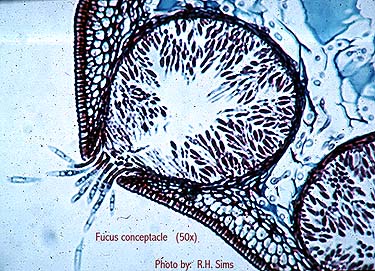
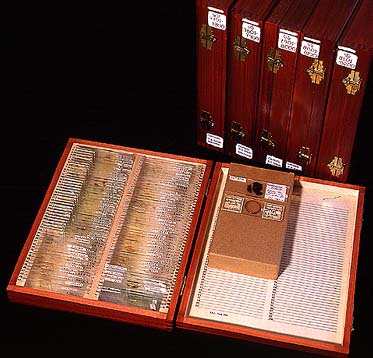
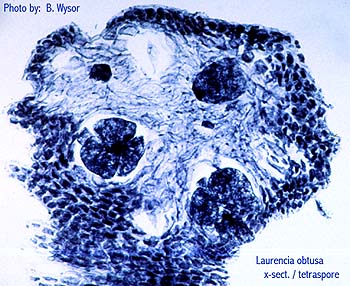
After satisfactory fixation in 3-5% buffered Formalin (about 15 to 30 minutes for more delicate forms and up to 24 hrs. for thick, cartilaginous algae), transfer the specimens to a clean watch glass or slide and rinse in distilled water. At this point, material may be sectioned if necessary. Stain the specimens with a solution approximately 1% v/v aqueous aniline blue (other stains, e.g., acid fuchsin, erythrosin, safranin, etc. are preferred by some investigators) for one (delicate, filamentous forms) to several minutes (thick forms); acidify with a drop of 1% HC1 to fix the stain, then wash with a drop or two of distilled water. Blot away excess water with filter paper.
Add Karo corn syrup diluted with distilled water (20-50%)* to which a preservative has been added (2-3% solution of phenol) to a specimen placed on a clean slide. Carefully cover with a coverslip (No. 1), attempting to avoid trapping bubbles. Add enough syrup to allow for evaporation. Store, flat and face-up, for one to two days; add more syrup (50% - 70%) around the edges of the coverslip, if necessary, to complete the seal. The Karo dries and hardens in a few days (sometimes a week or more). Therefore, slides should be stored flat and should not be allowed to stand on edge during the drying period. Caution should be exercised when cleaning the coverslip, so as not to scratch or dislodge it.
* Note: The concentration
of Karo will depend on the alga you are preparing. Some delicate forms
(e.g. Liagora) may require a 5-10% solution to begin with, while
others (e.g. Centroceras) may tolerate a 50% solution without causing
the cells to plasmolyze. After the initial addition of dilute Karo, you
may be able to use higher concentrations without damage to the cells.
This is a relatively rapid method for making semi-permanent preparations, either of sections or of whole mounts.
1. Fixation: Use 2-5% buffered Formalin seawater or an alcoholic fixative (70% EtOH). Allow 30 minutes for fixation, or longer if large cartilaginous specimens are involved.
2. Transfer the specimen to a solution that can be evaporated to leave 100% glycerin. The aim is to extract water from the specimen and replace it by glycerin with a minimum of shrinkage. The details vary according to the fixative and the characteristics of the specimen. For delicate specimens, the procedure should be performed on a pre-cleaned slide; larger, coarser thalli can be placed in small dishes and transferred to a slide for gel addition.
Aqueous fixatives. Transfer
the material to a 5% aqueous solution of glycerin, place on a warm plate
(50+ °C) and leave until concentrated. This usually will take overnight.
Remember that concentration to pure glycerin will diminish the volume
of solution to 1/20th of its original volume and that a specimen that
is allowed to dry is ruined. Cover to prevent dust accumulation when allowing
the glycerin to concentrate.
Alcoholic fixatives. Place in a 5% solution of glycerin in 70% EtOH and allow to concentrate as above.
3. Remove the specimen from the glycerin and blot dry. If the specimen is delicate, do not apply pressure, but simply use patience. Place the material on filter paper, or a paper towel and leave until no excess liquid glycerin is visible. Melt gel/stain mixture (see below) in a beaker placed in a water-bath and apply 3 drops to algal material which has been placed on a clean slide. The speed of staining is increased if the gel is kept molten for a few minutes and the slide rocked gently. Apply a coverslip (preferably No. 0). Bubbles diminish the life of glycerin-gel preparations. For this reason, never allow bubbles to form in the stock gel and never blow out a dropping pipette into molten gel. Should a bubble appear on a slide before applying the coverslip, the easiest way to remove it is to prick it with a red-hot needle.
Some researchers suggest that coverslips should be ringed with varnish or canada balsam. In general this is of no value in that, if the preparation is sealed, it appears to provide no security against drying-up and simply prevents repair. In the event that the gel retracts from the coverslip, add a sufficient amount of gel to fill-in the hole (this is not possible if the preparation has been ringed).
Gelatin 50 gm
Glycerin 350 ml
Water 300 ml
Mix, and heat in a beaker immersed in a water-bath until dissolved. Allow to cool and add 1 gm. phenol as a preservative. Add crystal-violet stain drop-wise until the required shade is achieved (usually determined by placing one drop of the solution on a microscope slide and placing a coverslip over it, aiming for a relatively dense color when viewed this way).
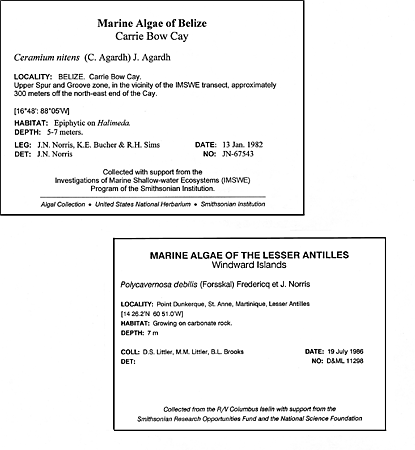
There are numerous variations in style; however a herbarium label should be on 100% rag paper and should contain the following information:
Geographic area of collection (i.e. name of island, county, state)
Binomial, including author(s)
Where collected, including latitude, and longitude if possible
Depth, substratum type, etc., including how collected (SCUBA, dredge, submersible, etc.)
Specific ecological information
Collector; date of collection
Collector's field number for specimen or collection
Person who identified the specimen
It is important to remember that the information gathered along with the specimen is just as important as the specimen itself. A collection notebook should be kept that details the collections' locality, habitat, water conditions etc. If necessary, it is possible to refer back to information in this notebook. When possible, the U.S. National Herbarium maintains collectors' notebooks along with the herbarium specimens for its major collections.
See the chapter by Tsuda and Abbott (1985) in the reference section for additional information.
Tsuda, Roy T. and Isabella A. Abbott. 1985. Collection, handling, preservation and logistics, pp. 67-68. In: Littler, M.M. and Littler, D.S. (eds.), Ecological Field Methods: Macroalgae. Handbook of Phycological Methods. Cambridge Univ. Press, New York, 617 pp.
Taylor, William Randolph. 1960. Marine Algae of the Eastern Tropical and Subtropical Coasts of the Americas. University of Michigan Press, Ann Arbor, Michigan, 870 pp. [See pgs. 32-43]
Abbott, Isabella A. and George J. Hollenberg. 1976. Marine Algae of California. Stanford University Press, Stanford, California, 827 pp. [See pgs. 8-15]
Abbott, I.A. and E.Y. Dawson. 1978. How to Know the Seaweeds. (2nd ed.) Wm. C. Brown Co. Publishers, Dubuque, Iowa, 141 pgs. [See pgs. 4-11]
Schneider, Craig W. and Richard B. Searles. 1991. Seaweeds of the Southeastern United States: Cape Hatteras to Cape Canaveral. Duke University Press, Durham, North Carolina, 553 pp. [See pgs.15-17]
Dawson, E. Yale. 1966. Marine Botany: An Introduction. Holt, Rinehart and Winston, Inc. New York, 371 pp. [See pgs. 318- 327]
Rollins, Reed C. 1955. The
Archer method for mounting herbarium specimens. Rhodora 57:
294-299. 
Reprinted from: