|
First
Aid for Electrical Accidents
Dawna
L. Cyr and Steven B. Johnson, Ph.D.
| First Aid For Electrical Accidents
- Disconnect the appliances or turn off the power if a person
is undergoing electric shock.
- Cover associated electric shock burns with a dry sterile
dressing only.
- Never touch a person undergoing electric shock or you
too could become a victim.
|
|
First Aid for
Electric Shock Victims
- Don't
touch them!
- Unplug
the appliance or turn off the power at the control panel.
- If you
can't turn off the power, use a piece of wood, like a broom handle,
dry rope or dry clothing, to separate the victim from the power source.
- Do not
try to move a victim touching a high voltage wire. Call for emergency
help.
- Keep
the victim lying down. Unconscious victims should be placed on their
side to allow drainage of fluids. Do not move the victim if there is
a suspicion of neck or spine injuries unless absolutely necessary.
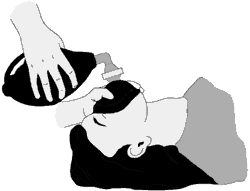
- If the
victim is not breathing, apply mouth-to-mouth resuscitation. If the
victim has no pulse, begin cardiopulmonary resuscitation (CPR). Then
cover the victim with a blanket to maintain body heat, keep the victim's
head low and get medical attention.
First Aid for
Electrical Burn Victims
 Electrical burns vary in severity depending upon: (1) how long the body
is in contact with the electric current; (2) the strength of the current;
(3) the type of current; and (4) the direction the current takes though
the body. Often these burns are deep. There may be more than one area
burned. One area may be where the current entered the body and another
may be where it left. Electrical burn wounds may look minor on the outside,
but could be severe on the inside.
Electrical burns vary in severity depending upon: (1) how long the body
is in contact with the electric current; (2) the strength of the current;
(3) the type of current; and (4) the direction the current takes though
the body. Often these burns are deep. There may be more than one area
burned. One area may be where the current entered the body and another
may be where it left. Electrical burn wounds may look minor on the outside,
but could be severe on the inside.
If a person
has received an electrical burn, check for shock and follow the steps
outlined above. If the person is conscious and there are no signs of shock
(such as being cold, clammy, pale and having a rapid pulse), begin treating
the burned area. Do not apply grease or oil to the burn. Cover the burn
with a dry, sterile dressing, but do not cool the burn. Keep the victim
from getting chilled. Seek medical attention as soon as possible. 
Source:
National Institute for Occupational Safety and Health
|



 Society
for Amateur Scientists
Society
for Amateur Scientists