Society
for Amateur Scientists
Beginner's Corner
Society
for Amateur Scientists
Beginner's Corner | |
|
|
|
|
Society
for Amateur Scientists
Beginner's Corner |
||
|
|||
|
|
|
Related Products Society for Amateur Scientists
|
|

sponsored by

|
Beginner's
Corner
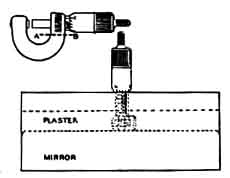
The illustrations show the simple yet efficient one devised by Paul G. Blaisdell, M.D., 102 N. Madison, Pasadena, Calif., and are almost self-explanatory. The anvil part of a five-and-ten-cent store micrometer calipers reading to a thousandth of an inch was sawed off along line A-B, in the Doctor's drawing, and discarded, leaving a stub for anchorage. A paper collar was fastened around the mirror disk, just as in preparing to make a pitch lap, as described in the book "Amateur Telescope Making," except much higher.
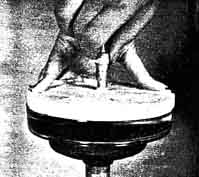
The spindle of the micrometer was run back till its end was flush with the remaining part of the frame, the micrometer was centered and held accurately on the glass, and plaster of Paris was poured around it. Before any grinding was done the actual reading of the spherometer was noted and used thereafter as its zero point. The photograph shows how it is used: the other hand holds the plaster disk in accurate register with the glass. Dr. Blaisdell states that this spherometer gave readings that checked with solar focus readings and cost only 35 cents to make. He obtained his micrometer from The Pep Boys, 169 W. Colorado St., Pasadena, for a little less than a quarter.
|
 ALMOST THE
FIRST concern of the beginner is to tell how deep the curve of his mirror
has been ground. The classic way to do this is by means of a curved template
but there are shorter, better methods.
ALMOST THE
FIRST concern of the beginner is to tell how deep the curve of his mirror
has been ground. The classic way to do this is by means of a curved template
but there are shorter, better methods.