Society
for Amateur Scientists
Beginner's Corner
Society
for Amateur Scientists
Beginner's Corner | |
|
|
|
|
Society
for Amateur Scientists
Beginner's Corner |
||
|
|||
|
|
|
Related Products Society for Amateur Scientists
|
|

sponsored by

|
Beginner's
Corner "Seldom have I seen in your columns a description of a satisfactory, easily made, yet rigid, secondary mirror support. I send a photograph of a type of support which I have used for 15 years in reflectors from 6" to 20" aperture. During that time I have found it to be the essence of rigidity, possessing the added merit of rapid adjustability. I do not claim originality of design; in fact the first telescopes in which I saw it used were those manufactured by Mr. J. T. Ward, of Wanganui, New Zealand. I strongly believe that a similar support was used by Browning, of London.
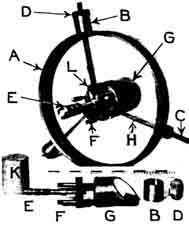
"My first reflector was a six inch, made in 1923 according to the articles by Ellison in English Mechanics. The flat support was made of the crudest materials, by the use of simple tools such as hacksaw, file, and a kit of bicycle tools, and it performed perfectly. "The photograph shows at the top a complete assembly for a 12-1/4" Cassegrain, and, below, a flat mount from a 10-1/2" Newtonian, the last mentioned instrument having been made for selenographical work [study and 7 mapping of lunar detail.-Ed.] A is a strong steel ring, which fits just outside or within the tube proper. At positions 120 degrees apart the steel ring, three bolts, C, pass through square holes cut in the ring. The fit is easy. These bolts are riveted to flat strips of spring steel, H, which form the spider. A sleeve, B, fits over the square portion (shown near C) of each bolt, and tension on the spider system is maintained by the knurled nuts D. The support for the mirror mount is a three armed steel spider, L, each arm being slotted and firmly bolted to a spring steel spider arm. "C is a brass tube holding the mirror. It is firmly attached to a circular steel plate by means of the three adjusting screws F. A helical steel spring fits over each adjusting screw and, for rigidity, is maintained at considerable compression. These springs are shown in the flat mount in the lower portion of the photograph. "The mirror mount is attached to the spider by means of the elongated nut E. This screws on to a bolt attached to the circular steel plate, and which passes through a hole bored or drilled in the heavy steel spider E is long, to facilitate attachment in the relative gloom of the interior of the tube. "The secondary mirror is adjusted centrally by the knurled nuts D. Collimation is effected by the adjusting screws F. "K is a light-weight metal cover which slips over the brass mirror mount when the telescope is placed away for the night. "Professor W. H. Pickering stated that the New England climate was the world's worst as far as observing was concerned. It could not possibly be worse than the Ozark climate in this respect. After ten years of it I find myself longing for the steady New Zealand atmosphere." When a prism is used for a diagonal the mount will of course be modified accordingly. Few types will need so fine a mount.
|
 BUGBEARS
OF THE tyro's first telescope include the mounting for the diagonal. From
S. R. B. Cooke, Assistant Professor of Metallurgy at the Missouri School
of Mines and Metallurgy, Rollo, Mo., and an amateur astronomer, we have
received the following:
BUGBEARS
OF THE tyro's first telescope include the mounting for the diagonal. From
S. R. B. Cooke, Assistant Professor of Metallurgy at the Missouri School
of Mines and Metallurgy, Rollo, Mo., and an amateur astronomer, we have
received the following: