Society
for Amateur Scientists
Beginner's Corner
Society
for Amateur Scientists
Beginner's Corner | |
|
|
|
|
Society
for Amateur Scientists
Beginner's Corner |
||
|
|||
|
|
|
Related Products Society for Amateur Scientists
|
|

sponsored by

|
Beginner's
Corner
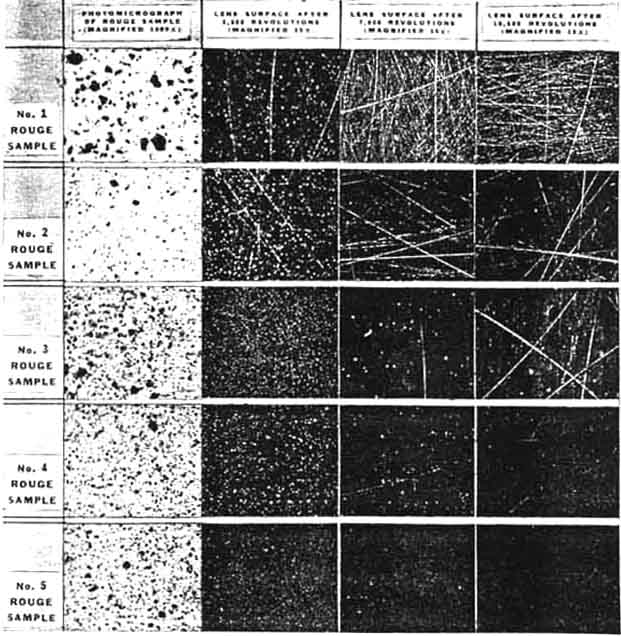
The photomicrographs shown below tell us something about rouge, and rouge, and rouge. Each horizontal row reveals the magnified surface of a lens which has rotated on a spindle under a different grade of rouge. This is machine work, it is true, but the findings apply equally to the amateur's hand work. Top row shows a rouge that would be very decidedly unsatisfactory. Each row below shows a better grade and the effects thereof. Only No. 5 (B. and L. 358-52738) is suitable for precision work. Now you have an idea, thanks to these high magnification close-ups, about the great differences between rouges. Yet they all look alike when seen at the bottom of the parcel they come in. It is worth while to go back and study the same photomicrographs again by vertical columns, comparing each. In the first column especially, note the bad but increasingly better particle size distribution. Study also the pitting effects of each, in photomicrographs to the right (pits shown by little white dots). As stated in the manual of the telescope making hobby, "Amateur Telescope Making," the particles of rouge are roughly 1/30,000 to 1/50,000 inch in diameter-that is, for good rouge.
|
 SOMETIMES
THE unsuspecting tyro telescope maker endeavors to economize by purchasing
low-priced rouge. Some have even used jeweler's rouge from their local
shops. Trouble often followed, which the beginner, without previous experience
by which to judge, regarded as unavoidable. There is rouge, and rouge;
yes, there is even rouge and rouge, and rouge. Polishing silverware
(jeweler's rouge) doesn't require anything fancy-this would be just a
waste of money. Polishing eyeglasses requires much better but not the
finest; the latter would therefore be a needless expense. Third standard
of work, precision optics (including telescope work) requires real Rolls
Royce rouge, but even that grade is inexpensive.
SOMETIMES
THE unsuspecting tyro telescope maker endeavors to economize by purchasing
low-priced rouge. Some have even used jeweler's rouge from their local
shops. Trouble often followed, which the beginner, without previous experience
by which to judge, regarded as unavoidable. There is rouge, and rouge;
yes, there is even rouge and rouge, and rouge. Polishing silverware
(jeweler's rouge) doesn't require anything fancy-this would be just a
waste of money. Polishing eyeglasses requires much better but not the
finest; the latter would therefore be a needless expense. Third standard
of work, precision optics (including telescope work) requires real Rolls
Royce rouge, but even that grade is inexpensive.