
Many of the projects described in the pages of the Amateur Scientist Department make use of sounds or electrical signals which lie in the audio frequency range of 20Hz to 20Khz. In the 50 or so years of the department, such signals have been used for everything from basic experiments on the physics of sound to levitating drops of water on water, oscillating flames, measuring the harmonics of a shower stall, and experimenting with chaos and encryption.
Just how does one obtain the controlled sounds and other signals? The professional or serious electronics hobbyist will probably already have some sort of signal generator. Such a device can generate a calibrated sine wave with frequency and amplitude both easily adjusted by the user over a large range. A more generally useful device is a function generator, which is capable of producing not only sine waves but square waves, sawtooths (ramps) and even pulses. These instruments are commonly available from a variety of manufacturers, and there is also a considerable surplus market. While important pieces of equipment to have however, signal and function generators are expensive, and it is often necessary to find other ways to generate the needed signals.
Depending on the desired frequency, there are a number of interesting ways to generate useful signals. By far the simplest source of a reliable, well known frequency is the AC power lines. In the US, the line frequency is a well regulated 60 Hz and all that is needed to harness the lines is a small AC wall transformer. Stepping the line voltage down to about 6.3 volts will enable the experimenter to use the lines (with care!) as a precise frequency standard. This is precisely how inexpensive digital alarm clocks get their time standard. The line voltage is stepped down and "clipped" with a zener diode to generate a square wave with a 5 volt amplitude, which is then used to clock the digital logic.
Other frequency standards are also easily available, though they are a bit harder to utilize. WWV, broadcast on shortwave frequencies of 2.5, 5, 10, 15 and 20 MHz, is the radio station of the National Institute of Standards and Technology (http://www.nist.gov/). The station broadcasts time signals linked to the agency's atomic clocks in Boulder, CO. In addition to the regular clicks, which serve to synchronize clocks, frequency standard audio tones are also transmitted. CHU, broadcasting from Ottowa at 3.330, 7.335 and 14.670 MHz is the Canadian equivalent of WWV.
More often than not, the experimenter needs to continuously vary the frequency or amplitude of a signal. For this, some elementary experience with electronic circuits is required. There are a variety of easy to use function generator chips available, such as the venerable ICL8038 (http://www.intersil.com/), or the more modern Maxim MAX038 (http://www.maxim-ic.com/). For generating pulses, square waves, ramps and other waveforms, almost nothing beats the simplicity and ease of use of the 555 timer IC chip. A trip to almost any neighborhood electronics store will turn up this IC and the necessary information to build several useful oscillator circuits. In addition, other more specialized chips can be used to produce quartz crystal oscillators with extremely stable frequencies.
The availability of cheap IBM compatible computers is also a boon to the experimenter in search of a simple signal generator. While newer operating systems make it hard to access the basic functions of the machine, an old PC running DOS, with QuickBasic installed is a great tool for the adept programmer. One has two options for generating square waves. The easiest is to write a program calling the "sound" function, which causes the speaker to beep for a programmed duration at a known frequency. One can then attach leads to the speaker outputs to obtain the needed signal.
Another simple method is to program the parallel port of the machine. By alternately driving one bit of the output data high and then low again, one can generate a square wave. In this case, since the rate at which the program runs depends on the speed of the machine, the frequency will have to be measured before use. The advantage is that pulses and other more complicated digital waveforms can also be generated in this fashion. In both cases, the output will have to be properly amplified if any current is to be drawn from the signal, in order to avoid damaging the computer.
Newer operating systems make it much more difficult to access the parallel port and other machine functions at a basic level. However, a computer's sound card is a perfect signal generator for the inclined experimenter. There are several good sound editing programs available at little or no cost on the World Wide Web. Several of these are capable of generating sine and other wave forms which can be played through the sound card. The volume control provides a convenient level adjustment.
Finally, there is one more simple and innexpensive alternative: an audio
CD with the signals one needs already programmed on it. All one needs for a
complete signal/function generator is a standard CD player, and some portables
can be found at discount electronics stores for under $30.
RefCD has been
designed as an inexpensive replacement for a number of signal and tone
generating devices which operate in the audio frequency range (~20 Hertz to
~20Khz). The Compact Disc contains a collection of tones (pure sine waves)
with precisely defined frequency. In addition, there are various more
specialized signals and waveforms for use in electronic troubleshooting,
repair, testing of electronic/audio equipment and general experimentation.
A booklet which completely describes the tracks comes with the CD and also
contains suggested methods and simple demonstrations.
For more information,
check out the RefCD page.
A poor person's frequency measurement
(How to measure frequency without a frequency counter)
While working with electronics, one often comes across the need to measure the frequency of a signal precisely. For example, electronic clocks need to run at the proper rate and radios must be tuned to an exact frequency to work properly. To measure frequency precisely, one uses a digital "frequency counter" or frequency meter. But suppose, as is often the case, you don't have a frequency counter and you still need to know the frequency. Can it be done?
With the proper equipment, the answer is yes. If you have an oscilloscope, the signal to be measured can be synchronized to a known signal and measured by comparison. It helps here to have a signal generator, capable of producing a precise, known frequency with which to compare the unknown signal. If a signal generator is not available, other sources can often be used (see "Signal Generators and their uses").
As an example, suppose you want to tune an oscillator to run at 60.0 Hz, to be used to run a clock. The oscillator output is first displayed on the oscilloscope and the trace stabilized. You can then measure the trace on the oscilloscope screen and determine the signal frequency to within a few percent, but a much better measurement is possible. The next step is to trigger the oscilloscope at exactly 60Hz. For this the line frequency is an excellent source. Some oscilloscopes have an internal 60Hz trigger setting. If not, connect a long dangling wire to another input channel or the external trigger, and trigger on that channel. The wire will pick up 60Hz inductively and serves as a trigger signal locked to the power line frequency.
The displayed trace may drift left or right on the scope because the trigger and display frequencies are not the same. If the trace drifts to the left, the unknown signal is running fast as the trigger signal is arriving later each cycle. If the signal drifts to the right, the unknown signal is slow. By measuring how long it takes to drift one complete cycle on the scope, the frequency of the displayed trace can be determined very precisely. For example, if the trace drifts left by one complete cycle in 45 seconds, the signal is running fast by 1 part in (45 * 60 cycles) = 1 / 2700 = 0.022. The frequency of the signal is thus 60.022Hz. The precision of this measurement can be arbitrarily determined up to the precision of the reference signal itself, just by counting cycles for a longer interval.
Even without an oscilloscope, all hope is not lost! As long as one has a known frequency standard, such as a tuning fork, the human ear can serve as an excellent instrument. By listening to the reference and signal tones simultaneously, a careful listener will hear "beats" when the two signals are very close in frequency. The beat frequency is caused by the interference of the two signals and is the difference of the two. For example, a signal of 441Hz will beat against a tuning fork of 440Hz (musical note "A") to produce a warbling tone once per second, indicating the signal is 1Hz off. This is exactly how musicians tune their instruments by ear.
To aid in the measurement of frequencies by the two methods described above, it is helpful to have easy access to a variety of precisely known "reference frequencies", like having a complete set of tuning forks for every note. Most often this is accomplised with high quality signal/function generators or synthesizers. RefCD is a compact disc designed to replace this expensive instrumentation. It is a standard audio disc which contains many tracks spanning the entire audio frequency range. All that is needed to generate presice audio tones is an innexpensive CD player.
For more information, check out the RefCD page.
A simple "SONAR" demo
For those with the interest in experimenting with sound and who have the equipment, but not the time, a very simple and relatively inexpensive demonstration of SONAR can be made in an evening. This experiment does require an oscilloscope and a pulse generator. In addition, an audio amplifier, and two inexpensive tweeters are required. The tweeters can be purchased for under $10 at stores such as Radio Shack, and other discount electronics sources. A typical home stereo amplifier will work fine.
Use one tweeter as an output and connect it to one channel of the audio amplifier. Connect the other tweeter to the input of the oscilloscope and place it next to the first one. It may help if they are touching. Aim both tweeters at a blank wall a few feet away, or at the ceiling. Using the pulse generator, feed a series of pulses of about 10 millisecond duration into the audio amplifier at a rate of about 10 Hz. Adjust the volume slowly until ticks are heard. Set the trigger on the scope carefully to begin sweeping as a tick occurs, and select a sweep rate of 1 to 10 millisec/cm. The "tick" seen on the scope will probably not be the nicely shaped pulse input to the tweeter, but a complicated waveform containing resonance frequencies of the tweeter.
Carefully adjust the sensitivity of the scope until the reflected pulse is seen in the trace. The trigger pulse may be off the top of the screen at this point. Slowly increase the volume if necessary. The reflected pulse can be picked out from other spurious signals by moving a large card back and forth in front of the tweeters a few feet away. The reflected pulse will move on the oscilloscope trace correspondingly. Using the scope to measure the transit time of the "tick" and knowing the distance one can determine the speed of sound. Alternatively, if one knows the speed of sound, the setup can be used to determine the distance to the card, which is the principle on which sonar is based.
RefCD contains a
special track designed for just this demonstration. It consists of a 10Hz
pulse train of narrow, rapidly decaying pulses, and eliminates the need
for a pulse generator. Any home CD player will thus work as the signal
source, levaing the oscilloscope as the only piece of specialty equipment
required for this experiment.
For more information,
check out the RefCD page.
Brought to you by...
For those with the interest in experimenting with sound and who have the equipment, but not the time, a very simple and relatively inexpensive demonstration of SONAR can be made in an evening. This experiment does require an oscilloscope and a pulse generator. In addition, an audio amplifier, and two inexpensive tweeters are required. The tweeters can be purchased for under $10 at stores such as Radio Shack, and other discount electronics sources. A typical home stereo amplifier will work fine.
Use one tweeter as an output and connect it to one channel of the audio amplifier. Connect the other tweeter to the input of the oscilloscope and place it next to the first one. It may help if they are touching. Aim both tweeters at a blank wall a few feet away, or at the ceiling. Using the pulse generator, feed a series of pulses of about 10 millisecond duration into the audio amplifier at a rate of about 10 Hz. Adjust the volume slowly until ticks are heard. Set the trigger on the scope carefully to begin sweeping as a tick occurs, and select a sweep rate of 1 to 10 millisec/cm. The "tick" seen on the scope will probably not be the nicely shaped pulse input to the tweeter, but a complicated waveform containing resonance frequencies of the tweeter.
Carefully adjust the sensitivity of the scope until the reflected pulse is seen in the trace. The trigger pulse may be off the top of the screen at this point. Slowly increase the volume if necessary. The reflected pulse can be picked out from other spurious signals by moving a large card back and forth in front of the tweeters a few feet away. The reflected pulse will move on the oscilloscope trace correspondingly. Using the scope to measure the transit time of the "tick" and knowing the distance one can determine the speed of sound. Alternatively, if one knows the speed of sound, the setup can be used to determine the distance to the card, which is the principle on which sonar is based.
RefCD contains a special track designed for just this demonstration. It consists of a 10Hz pulse train of narrow, rapidly decaying pulses, and eliminates the need for a pulse generator. Any home CD player will thus work as the signal source, levaing the oscilloscope as the only piece of specialty equipment required for this experiment.
For more information, check out the RefCD page.
Brought to you by...
While working with electronics, one often comes across the need to measure the frequency of a signal precisely. For example, electronic clocks need to run at the proper rate and radios must be tuned to an exact frequency to work properly. To measure frequency precisely, one uses a digital "frequency counter" or frequency meter. But suppose, as is often the case, you don't have a frequency counter and you still need to know the frequency. Can it be done?
With the proper equipment, the answer is yes. If you have an oscilloscope, the signal to be measured can be synchronized to a known signal and measured by comparison. It helps here to have a signal generator, capable of producing a precise, known frequency with which to compare the unknown signal. If a signal generator is not available, other sources can often be used (see "Signal Generators and their uses").
As an example, suppose you want to tune an oscillator to run at 60.0 Hz, to be used to run a clock. The oscillator output is first displayed on the oscilloscope and the trace stabilized. You can then measure the trace on the oscilloscope screen and determine the signal frequency to within a few percent, but a much better measurement is possible. The next step is to trigger the oscilloscope at exactly 60Hz. For this the line frequency is an excellent source. Some oscilloscopes have an internal 60Hz trigger setting. If not, connect a long dangling wire to another input channel or the external trigger, and trigger on that channel. The wire will pick up 60Hz inductively and serves as a trigger signal locked to the power line frequency.
The displayed trace may drift left or right on the scope because the trigger and display frequencies are not the same. If the trace drifts to the left, the unknown signal is running fast as the trigger signal is arriving later each cycle. If the signal drifts to the right, the unknown signal is slow. By measuring how long it takes to drift one complete cycle on the scope, the frequency of the displayed trace can be determined very precisely. For example, if the trace drifts left by one complete cycle in 45 seconds, the signal is running fast by 1 part in (45 * 60 cycles) = 1 / 2700 = 0.022. The frequency of the signal is thus 60.022Hz. The precision of this measurement can be arbitrarily determined up to the precision of the reference signal itself, just by counting cycles for a longer interval.
Even without an oscilloscope, all hope is not lost! As long as one has a known frequency standard, such as a tuning fork, the human ear can serve as an excellent instrument. By listening to the reference and signal tones simultaneously, a careful listener will hear "beats" when the two signals are very close in frequency. The beat frequency is caused by the interference of the two signals and is the difference of the two. For example, a signal of 441Hz will beat against a tuning fork of 440Hz (musical note "A") to produce a warbling tone once per second, indicating the signal is 1Hz off. This is exactly how musicians tune their instruments by ear.
To aid in the measurement of frequencies by the two methods described above, it is helpful to have easy access to a variety of precisely known "reference frequencies", like having a complete set of tuning forks for every note. Most often this is accomplised with high quality signal/function generators or synthesizers. RefCD is a compact disc designed to replace this expensive instrumentation. It is a standard audio disc which contains many tracks spanning the entire audio frequency range. All that is needed to generate presice audio tones is an innexpensive CD player.
For more information, check out the RefCD page.
Brought to you by...
 RefCD contains a variety of si=
gnals
which can be used to test and calibrate audio equipment, troubleshoot =
electronic designs and perform a range of simple demonstrations. The =
accuracy of the tones is limited only by the quality of the CD player use=
d =
to reproduce the tracks. Frequencies from 20Hz to the 22KHz limit of a =
CD player can be reproduced with 16 bit resolution.
RefCD contains a variety of si=
gnals
which can be used to test and calibrate audio equipment, troubleshoot =
electronic designs and perform a range of simple demonstrations. The =
accuracy of the tones is limited only by the quality of the CD player use=
d =
to reproduce the tracks. Frequencies from 20Hz to the 22KHz limit of a =
CD player can be reproduced with 16 bit resolution.
With RefCD, a CD player and an oscilloscope is all you need to perform =
a large number of tests and demonstrations.
Add an audio amplifier and you can test small motors and and carry out
demonstrations on the physics of sound
(
*).
Some examples of tracks from RefCD and their uses are listed below.
| Functi= on | Application |
|---|---|
| Pure sine waves | Various uses= |
| Musical notes (sine waves)= | Tunin= g instruments, play simple tunes (use a programmable CD player) |
| Frequency sweep, 1Hz-10KHz= | Frequency= response of amplifiers, test equipment, hearing tests |
| Amplitude sweep(1.000Khz)<= /font> | Linearity tests, hearing e= xperiments |
| Signal in right channel on= ly | Channel separation test of= audio equipment |
| 60Hz "push/pull" sine or s= quare wave | Testing transformers, powe= r intverters, motors, check tracking speed of CD players<= /td> |
| Sine on right channel, Cos= ine on left channel | Demonstrations of sine and= cosine, 2 phase motors |
| 1.000Khz on right, 999.0 H= z on left | Demonstration of relative = phase, test phase lock circuits, demonstration of interference of sound waves |
| 1.000Khz AM and FM | Demonstrate modulation, te= st demodulators |
For more information and pu= rchases, check out www.RefCD.com
* = This CD is intended for use as a signal/function generator, but some of t= he tracks on this CD are NOT meant to be played through speakers. Some of the tones, the low frequencies in particular, can very quickly burn out a typical speaker. Care must be used at all times when reproduci= ng pure tones through an audio amplifier.
This web page and RefCD are Copyright 2000 by Daniel Koller.
Seismograph amplifiers are designed to operate at very low frequencies, typically from 10Hz down to direct current. When analyzing the data recorded by a seismograph, it is desirable to know the frequency response of the amplifier, to insure that it is relatively flat. Otherwise some signals could be emphasised over others, leading to an erroneous interpretation of the seismogram. At the very least, the operator needs to know that the amplifier has low drift for DC inputs, and that the nominal gain is correctly set. How does one go about testing such an amplifier?
Ideally, one can apply a very low frequency (VLF) input
signal to the amplifier and observe the output on an oscilloscope.
A voltmeter could also be used, provided it is fast enough to track the
changes in the output without delays in the reading. Care should
be taken to avoid using the AC ranges as they may not linear at such low
frequencies. The problem then is how to obtain the necessary low
frequency input. Very low frequency signal generators are commercially
available, but they are relatively rare and expensive. It is also
possible to
build a circuit using a function generator IC (see "Signal
Generators and their uses").
An attractive alternative is to produce a relatively easily
generated audio frequency tone and modulate
it at the appropriate
low frequency. This is most easily done on a PC with the
appropriate software. Several shareware programs available on
the World Wide Web will allow
the user to generate a very precise, modulated sine wave. The
sound is then played back through the sound card and demodulated
to produce the required VLF signal. A simple demodulation circuit
is as follows:
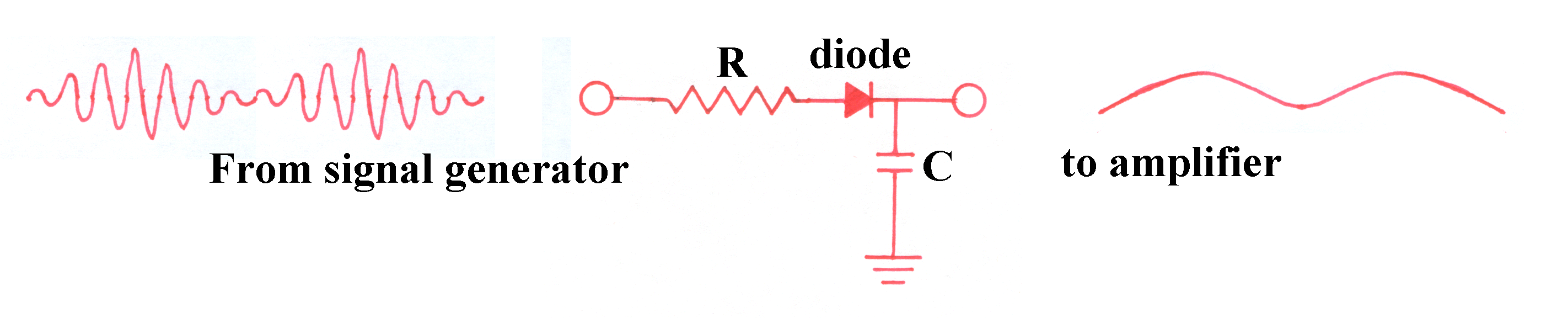
RefCD
contains a special track designed for just this test. It consists of a
1KHz sine wave
modulated +/- 10% by a 1Hz sine
wave. One utilizes a CD player to play back the track through the
simple circuit above, thus eliminating the need for a low frequency oscillator.
For more information, check out the RefCD page.
Brought to you by...