Hands-On Astrophysics uses the unique variable star database of the American
Association of Variable Star Observers (AAVSO). It is a curriculum suitable
for high school and college science, math, and computer science classes, and
directly involves students in the scientific process.
 |
| Students use HOA to learn astronomy. |
Hands-On Astrophysics will help students acquire fundamental science skills
and develop an understanding of basic astronomy concepts; it will provide
interdisciplinary connections, and take students through the whole
scientific process while working with real data. This curriculum also will
inform students about variable stars and their importance to the
professional astronomical community, and give them the necessary information
and skills to study variable star behavior or to become amateur variable
star observers.
This curriculum supports the
National Standards for Science
and Math Education by directly
involving students in the
scientific process.
Each unit contains a paragraph
which describes the specific
National Science Standards and
Benchmarks themes, concepts,
and content addressed in its
chapters.
Students learn the necessary skills to make observations, analyze their data
with graphing and statistical techniques, make predictions, and compare
predicted and observational values, as well as learn how to develop
sophisticated mathematical models. Students will learn about variable stars
by using the activities, software, charts, slide sets, and videos that
accompany the teacher and student manual. Students will be able to access
the AAVSO database, and share their investigations and observations with
other students via the internet web site specially developed for this
project.
 |  |
| Star is Bright | Star is Faint |
| Above is a 'star field print' of the variable W Cygni in action. |
The study of variable stars is particularly suited to science, math, and
computer education. Students can observe variable stars, and analyze the
brightness changes in the stars they observe by using the database of
600,000 observations and the computer programs provided. Except for a few
exercises in skill development, there are no "right" answers in this
curriculum. The data obtained and the results of the analysis of that data
by students is the "right" answer. The amount of data and the mathematical
refinement techniques will give reasonably accurate results. Students will
understand that their observations can be reliable, and that their data can
be useful enough to be used by professional astronomers.
Hands-On Astrophysics
includes the following materials:
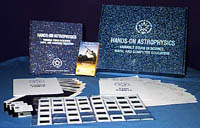 |
| The Hands-On Astrophysics Package is available through the AAVSO. |
- A Teacher/Student Manual.
- Computer software (PC compatible):
VSTAR, a data plotting and analysis program;
HOAENTER, a data entry program; and
HOAFUN, an introduction to variable stars,
including a variable star observing game.
- 45 variable star charts.
- 14 prints of the Cygnus star field.
- 31 slides of 5 constellation areas.
- 1 video cassette in 3 segments:
"Backyard Astronomy"; "Variable Stars";
and "How to Observe Variable Stars."
Hands-On Astrophysics
Chapter Contents:
- The Solar System and Beyond
- The Nature of Stars
- Familiarizing Yourself with the Night Sky
- Our Bearings in the Sky
- Introducing the Hands-On Astrophysics
Constellations
- Measuring Variable Stars Visually
- Observing Variable Stars in the Real Sky
- The Nature of Light
- The Life of a Star
- Statistical Concepts
- Variable Stars, Light Curves, and Periodicity
- Variable Stars and Phase Diagrams
- Variable Stars and O-C Diagrams
- Appendices
Hands-On Astrophysics Website (diagram)
Eclipsing Binary Stars: Observing Procedures/Objectives
Summary of Variable Star Types
AAVSO Program Stars in the HOA
Software Instructions
Resource List
For Further Reading
Glossary-
Glossary/Subject Index-
|
![[HOA Logo]](hoa_shield.gif)